
Exhibition Archives - Page 3 of 10 - World Chess Hall of Fame & Galleries

Golf the Galleries 2021

Exhibit Overview

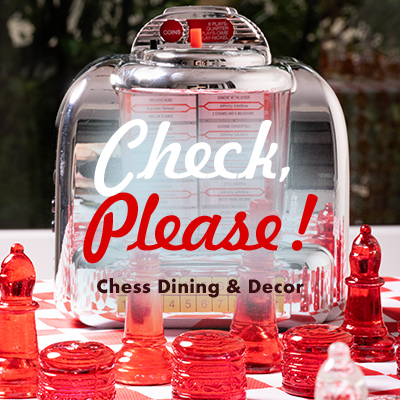
For its fourth collaboration with The Sheldon Concert Hall and Art Galleries’ Golf the Galleries, the World Chess Hall of Fame (WCHOF) presents Check, Please! an off-site experience of our current exhibition Check, Please! Chess Dining & Decor. Food, like the game of chess, brings people together. Check, Please! includes food and drink-themed chess sets and chess-inspired home decor from the collection of the WCHOF. With a mission to promote the cultural aspects of the game of chess, the WCHOF seeks to demonstrate that chess is everywhere! Though chess is often seen as a competitive sport and a game of war, there is also a very fun and whimsical side of the ancient game. Check, Please! is an immersive exhibition designed to invite visitors into fun, familiar environments decorated by food and drink-themed decor inspired by chess.

The WCHOF celebrates one of the world’s oldest and best-loved games through vibrant, engaging exhibitions and creative programming. A non-profit, collecting Institution, the WCHOF houses both the U.S. and World Chess Halls of Fame, which honor the accomplishments of the game’s finest players. Our mission is to educate visitors, fans, players and scholars by collecting, preserving, exhibiting and interpreting the game of chess and its continuing cultural and artistic significance. Unique shows and programs are designed to appeal to both the chess novice and expert, defying expectations and enhancing knowledge of the game. Along with those of its sister organization, the Saint Louis Chess Club, the WCHOF’s activities have distinguished Saint Louis as a national and international chess destination.

At this hole, play through the chess pieces that are lined up like candy canes! Then, to continue to enjoy chess and food and drink, scan the in-person QR code for a free coffee when you visit Kingside Diner on the Saint Louis Chess Campus!

Golf the Galleries is on view for a limited time, July 2 – September 6, 2021
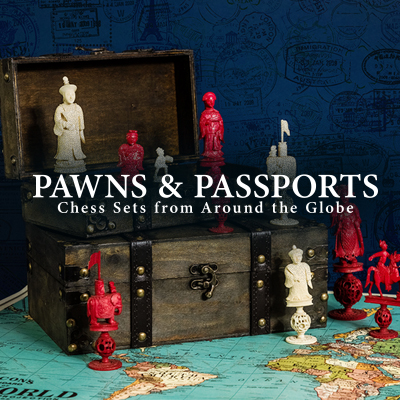
Pawns & Passports: Chess Sets from Around the Globe

Exhibits Overview

In September of 2021, the WCHOF will celebrate our tenth anniversary in Saint Louis. When the institution moved from Miami to Saint Louis, it already boasted a collection of over 163 chess sets. However, through the generosity of numerous donors as well as some purchases, it has increased to include over 1200 sets  from over 65 countries. Since our opening, we have hosted numerous exhibitions blending chess with art, history, and popular culture. Among these have been many shows featuring chess sets from our collection and those from lenders around the United States and the world. Pawns & Passports: Chess Sets from Around the Globe includes highlights from the diverse chess set collection of the World Chess Hall of Fame (WCHOF). Through this display, we hope to give visitors the opportunity to “travel” around the world from our gal-lery. We also would like to highlight the stories these sets tell, both through their imagery and the stories of how they traveled from their places of origin to our location in Saint Louis.

Chess History

Since chess’s creation, people of different regions have transformed the pieces to reflect their own cultures and history. While the pieces originally reflected units in the Indian military, replete with chariots, cavalry, elephants, and military advisors, European chess set creators later included pieces like bishops and queens, reflective of their own political structures. In 1849, the Staunton-style chess set was introduced to the public. Though it has since become the standard set for tournament play around the world, people still create sets with unique imagery. Some are meant more for display rather than for play and their appearances draw from stories, history, or local artistic traditions. The sets on view in Pawns & Passports have diverse stories. Many are local variations on playing sets, while others are pieces produced as souvenirs. We invite you to learn more about them through this selection of activities.

Connection to WCHOF Mission

The WCHOF is dedicated to interpreting the game of chess and its continuing cultural and artistic significance. Chess, with its opposing sides and rich history, has proven an attractive arena for artists and creators to explore different imagery and stories. As chess has spread around the world, it has attracted the attention of artists and creators who have made sets that incorporate themes and stories from their own cultures.

Keith Haring: Radiant Gambit

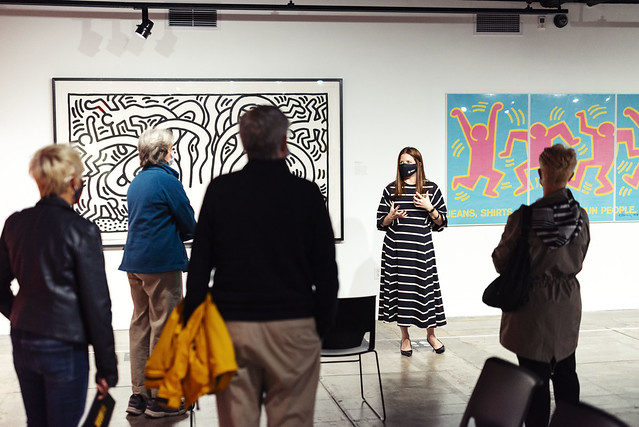
Keith Haring: Radiant Gambit features artwork by Haring, a world-renowned pop artist known for his art that proliferated in the New York subway system during the early 1980s. The exhibition includes a never-before-seen private collection of Haring’s works and photographs of the artist, bespoke street art chess sets from Purling London and newly-commissioned pieces by Saint Louis artists, all paying homage to the late pop culture icon.

Keith Haring: Radiant Gambit Opening Reception

Keith Haring (1958-1990) emerged as the shooting star of the New York art scene in the 1980s. Becoming world famous almost overnight, his simply drawn figures were soon to be found on watches and cars, T-shirts, and shopping bags, turning Haring into one of the best- known artists of his generation.

He was born in Reading, Pennsylvania, on May 4, 1958, and was raised in nearby Kutztown. As a child, Haring developed a love for drawing. He was fascinated by the cartoon art of Walt Disney and Charles Schultz and the illustrations of Dr. Seuss. He graduated from high school in 1976 and studied at the Ivy School of Art in Pittsburgh, a commercial arts school. After dropping out, after two semesters, he continued to create art and had a solo exhibition at the Pittsburgh Arts and Crafts Center in 1978.

In 1978, Haring moved to New York City to attend the School of Visual Arts. He then discovered a thriving alternative art community that was developing outside of the formal museum and gallery setting but rather in the streets of downtown New York, clubs, and the subways. He became friends with fellow artists Kenny Scharf and Jean-Michel Basquiat, musicians such as Madonna, and other performance and graffiti artists who comprised the burgeoning art community. Haring thrived with this crowd and energy and began exhibiting in and organizing exhibitions and performances in alternative spaces.

In addition to being impressed by the innovation and energy of his contemporaries, Haring was also inspired by the work of Jean Dubuffet, Pierre Alechinsky, William Burroughs, Brion Gysin, and Robert Henri’s manifesto The Art Spirit, which asserted the fundamental independence of the artist. With these influences Haring was able to push his own youthful impulses toward a singular kind of graphic expression based on the primacy of the line. Also drawn to the public and participatory nature of Christo’s work, in particular Running Fence, and by Andy Warhol’s unique fusion of art and life, Haring was determined to devote his career to creating a truly public art.

In 1980, Haring received public attention with his public art in subways. He had found a highly effective medium that allowed him to communicate his work with a wider audience, and he created white chalk drawings on the unused advertising panels covered with matte black paper in subway stations. He considered the subways to be his “laboratory.” Between 1980 and 1985, he produced hundreds of these “subway drawings.” His signature images included dancing figures, a “radiant baby” (a crawling infant emitting rays of light), a barking dog, a flying saucer, large hearts, and figures with televisions for heads. These graffiti drawings became familiar to New York commuters, who would often stop to engage with the artist. He also attracted the attention of the city authorities which arrested him for vandalism on numerous occasions.

Between 1980 and 1989, Haring achieved international recognition and participated in numerous group and solo exhibitions. His first solo exhibition in New York was held at the Westbeth Painters Space in 1981. In 1982, he made his Soho gallery debut with an immensely popular and highly acclaimed one-man exhibition at the Tony Shafrazi Gallery. During this period, he also participated in renowned international survey exhibitions such as Documenta 7 in Kassel, the Sao Paulo Biennial, and the Whitney Biennial. Haring completed numerous public projects in the first half of the 1980s as well, ranging from an animation for the Spectacolor billboard in Times Square, designing sets and backdrops for theaters and clubs, developing watch designs for Swatch and an advertising campaign for Absolut vodka; and creating murals worldwide.

In 1986, Haring opened a retail store called the Pop Shop in Soho, New York in order to provide people greater access to his art at a low price point. The shop sold T-shirts, posters, magnets, toys, and buttons bearing his images. Haring believed that the entire shop was a piece of his art and painted black and white murals throughout the entire space.

Throughout his career, Haring devoted much of his time to public works, which often carried social messages. He produced more than 50 public artworks between 1982 and 1989, in dozens of cities around the world, many of which were created for charities, hospitals, children’s day care centers and orphanages. The now famous Crack is Wack mural of 1986 has become a landmark along New York’s FDR Drive. Other projects include: a mural created for the 100th anniversary of the Statue of Liberty in 1986, on which Haring worked with 900 children; a mural on the exterior of Necker Children’s Hospital in Paris, France, in 1987; and a mural painted on the western side of the Berlin Wall three years before its fall. Haring also held drawing workshops for children in schools and museums in New York, Amsterdam, London, Tokyo, and Bordeaux, and produced imagery for many literacy programs and other public service campaigns.

Throughout his brief career, Haring was featured in more than a hundred solo and group exhibitions and produced more than 50 public artworks in cities around the world many of which were created for charities, orphanages, hospitals and children’s day care centers. He also designed around 85 posters. These included advertisements for exhibitions of his own work as well as cultural events or political issues. Haring’s drawings themselves incorporate the clear cut lines and reduced features needed for effective posters, which have to stand out and be understood at a glance. The uni-colored backgrounds help to make the outlined figures and drawings even clearer. The content of the advertisement is apparent in the illustration — the text being of secondary importance. Haring’s colorful posters, with their precise pictorial language, direct messages, and universal appeal, still exert an incomparable fascination on us to this day.

Haring was socially conscious, and his murals often reflected his position on social issues. He sought to raise awareness of AIDS and fought against the proliferation of illegal drugs.

In 1988, he was diagnosed with AIDS. The following year, he created the Keith Haring Foundation in order to raise awareness of AIDS and to provide funding to AIDS organizations and children’s programs, which is still in operation today. They continue to promote his artwork and his messages through the support of exhibitions, like this one at the World Chess Hall of Fame, various publications, and the licensing of his images.

Keith Haring died of AIDS-related complications on February 16, 1990, at the age of 31. During his very brief career his work was featured in over 100 solo and group exhibitions. In 1986 alone, he was the subject of more than 40 newspaper and magazine articles. He was highly sought after to participate in collaborative projects, and worked with artists and performers as diverse as Madonna, Grace Jones, Bill T. Jones, William Burroughs, Timothy Leary, Jenny Holzer, Yoko Ono, and Andy Warhol.

By expressing universal concepts of birth, death, love, sex, and war, using a primacy of line and directness of message, Haring was able to attract a wide audience and assure the accessibility and staying power of his imagery, which has become a universally recognized visual language of the 20th and 21st centuries. His work is part of significant private and public collections including the Whitney Museum of American Art, the Los Angeles County Museum of Art, the Art Institute of Chicago, the Musee Art Moderne de la Ville de Paris, the Carnegie Museum of Art, The Andy Warhol Museum, and the Stedelijk. His murals still exist throughout the world.

By Shannon Bailey, Chief Curator.

Special thanks to the Keith Haring Foundation and Katharine Wright, PhD, for providing content for this biography.

Downloads

Keith Haring: Radiant Gambit Activity Book:

Stan Chisolm Coloring Section:

Dail Chambers Coloring Section:

Edo Rosenblith Activity:

Peat “EYEZ” Wollaeger Activity:

Single Source Travelling Exhibition organized by: Pan Art Connections Inc. www.pan-art-connections.com


Keith Haring: Radiant Gambit is supported by the Missouri Arts Council, a state agency.

Press

6/11/2021: St. Louis Magazine — Congratulations, A-List 2021 winners and finalists!

5/16/2021: Insider Hook — A New Exhibit Offers a Comprehensive Overview of Keith Haring’s Art

5/15/2021: Hyperallergic — The Darker Side of Keith Haring

5/13/2021: KSDK — Keith Haring art on display in St. Louis

5/12/2021: River Front Times — St. Louis’ World Chess Hall of Fame Hosting Massive Keith Haring Exhibit

5/11/2021: CWE Scene — “Keith Haring: Radiant Gambit” Closing Reception

4/15/2021: Artvoice — World Chess Hall of Fame Celebrates Keith Haring

4/13/2021: Artlyst — Keith Haring: Personal Spiritual Imagery – Revd Jonathan Evens

4/10/2021: Peace and Love Lifestyle — Upcoming Chess Prodigies

4/8/2021: Stuck At The Airport — THE PLACES WE’LL GO: WORLD CHESS HALL OF FAME

4/1/2021: American Towns — St. Louis Featured Events – Exhibition – Keith Haring: Radiant Gambit

4/1/2021: Newsbreezer — Keith Haring also performed her famous street chess in the Hall of Fame Chess Players

3/29/2021: Art Daily — World Chess Hall of Fame exhibition celebrates the legacy of Keith Haring

3/25/2021: CWE Scene — 5 Things To Do In The CWE This Weekend: March 25-28

3/11/2021: Stay Happening — Curator Tour: “Keith Haring: Radiant Gambit” and “Masterminds: Chess Prodigies”

1/15/2021: Fox 2 News — Pop artist Keith Haring exhibit now on display at the St. Louis World Chess Hall of Fame

1/14/2021: travelandleisure.com — Art and Chess Combine at the World Chess Hall of Fame’s Incredible Keith Haring Exhibit

1/14/2021: STL Magazine — https://www.stlmag.com/culture/radiant-gambit-world-chess-hall-of-fame-k…

1/7/2021: fordors.com — Loveœ”The Queen’s Gambit”? Then You Might Like These 7 Places

1/7/2021: choicehotels.com — Top Things to Do with Kids in St. Louis

12/17/2020: HEC TV — Keith Haring: Radiant Gambit at the World Chess Hall of Fame

11/10/2020: New York Times — ‘Queen’s Gambit’ Clothes Make Us Want to Toss Our Leggings


Featured Chess Sets 2021

Through the Featured Chess Set project, the World Chess Hall of Fame showcases a variety of chess sets throughout the year. These include highlights from our own collection as well as chess sets owned by friends and chess lovers who have special stories to accompany their sets

December

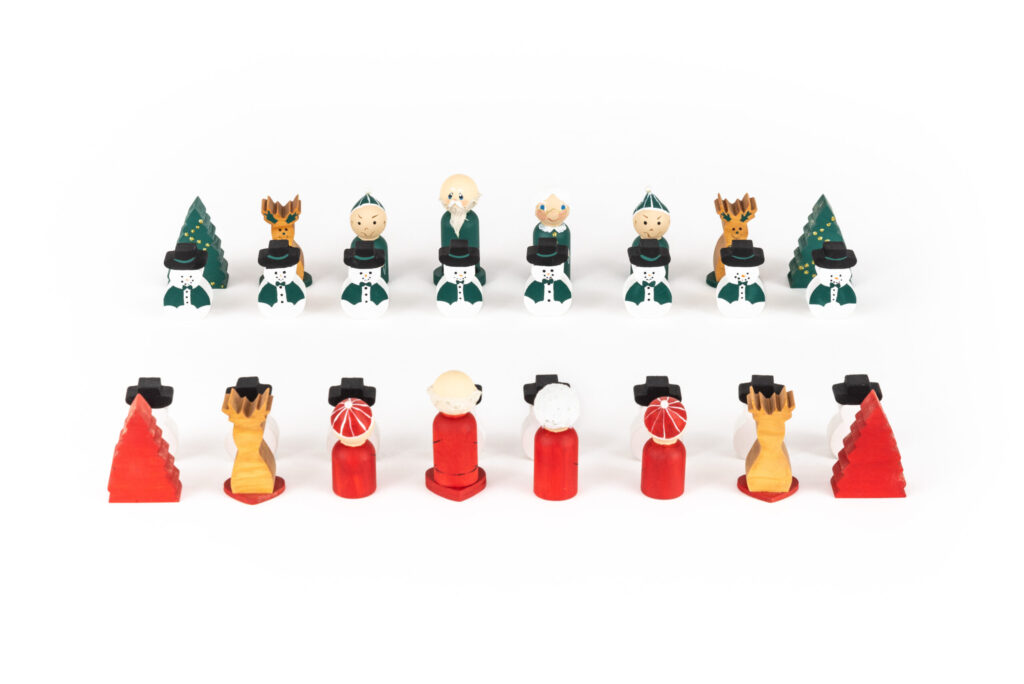
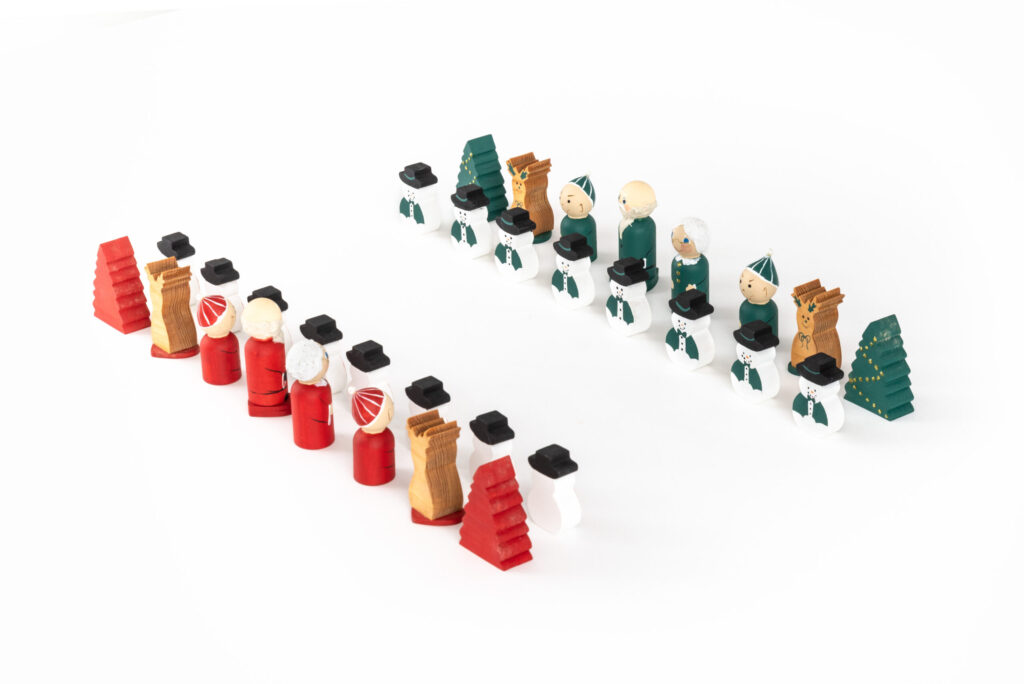
December’s Featured Chess Set is part of the collection of the World Chess Hall of Fame (WCHOF). Since its creation in 1986, the WCHOF has endeavored to highlight the history and cultural significance of the game of chess. The WCHOF’s collection is diverse and includes sets once owned by legendary players, mass-produced sets with lively pop culture themes, antique ivory sets, travel sets, as well as chess computers. Through these artifacts, the WCHOF illustrates how chess has evolved through its over 1500-year history. This set is part of the museum’s permanent collection.

Maker unknown
Christmas Chess Set
c. late 20th century-early 21st century
King size: 2 ½ in.
Wood
Collection of the World Chess Hall of Fame, gift of Bernice and Floyd Sarisohn

Santa and Mrs. Claus make an appearance in this Christmas-themed chess set. Instead of black and white, the pieces are separated into red and green. Snowmen play the role of pawns, and instead of rooks, Christmas trees have the ability to move forwards, backwards, and sideways. Reindeer are the obvious choice for knights, and mischievous elves act as bishops. Bernice and Floyd Sarisohn gifted the World Chess Hall of Fame with this festive chess set in 2020.

November

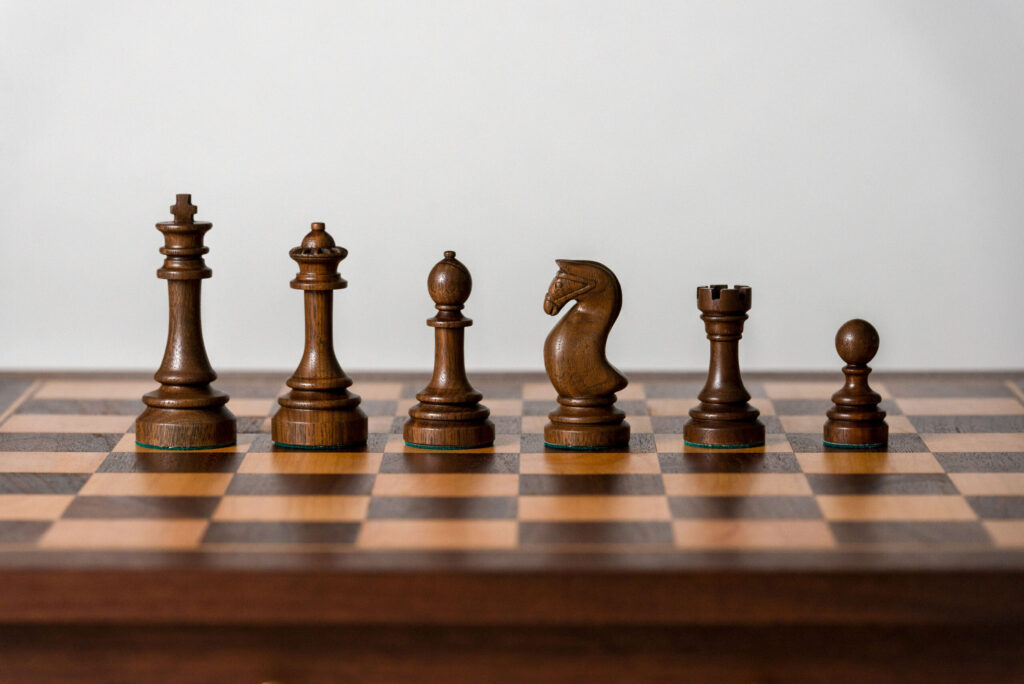
November’s Featured Chess Set is a loan from the collection of Libby Fennewald. Her father, Earl Jeffers Ph.D., created the set as one of six heirloom sets for members of his family. Jeffers has a background as an educator, and he was one of the founding members of the Western North Carolina Wood-turners Club. He has given demonstrations on various aspects of how to use a wood lathe.

Earl Jeffers Ph.D.
Heirloom Chess Set 
2019
King size: 4 3/4 in.
Board: 4 x 22 x 22 in.
Walnut, maple, and birch
Collection of Libby Fennewald

This handsome Staunton-style chess set has weighted pieces and a beautiful chessboard complete with a drawer for storing its pieces between games. Earl Jeffers Ph.D., the creator of the chess set, wrote a book documenting how to make the chess set and board at the urging of his family after producing his first heirloom chess set. Titled Designing and Crafting an Heirloom Chess Set (2020), the book includes step-by-step instructions along with photographs, showing how to make a set of one’s own. He has also produced an abridged version of the book titled Creating a Classic Chess Set: Easy Step Procedures for Success (2020). Both are available for purchase in Q Boutique if you would like to learn more about how to make your own keepsake chess set.

October

October’s Featured Chess Set is part of the collection of the World Chess Hall of Fame (WCHOF). Since its creation in 1986, the WCHOF has endeavored to highlight the history and cultural significance of the game of chess. The WCHOF’s collection is diverse and includes sets once owned by legendary players, mass-produced sets with lively pop culture themes, antique ivory sets, travel sets, as well as chess computers. Through these artifacts, the WCHOF illustrates how chess has evolved through its over 1500-year history. This set is part of the museum’s permanent collection.

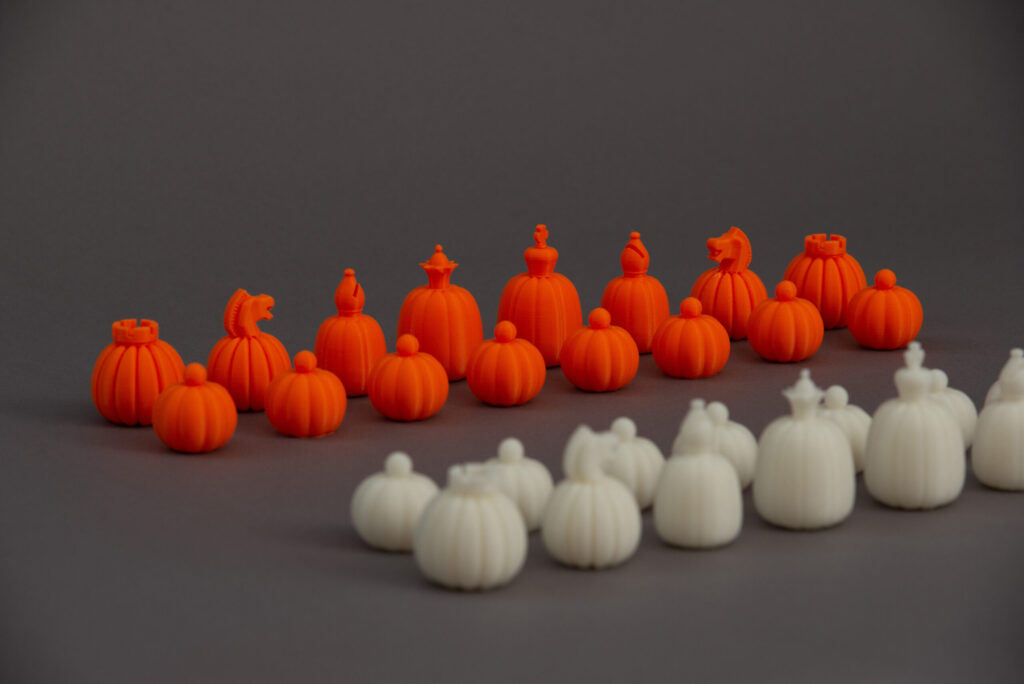
TrixtrDesign
Pumpkin Chess Set
2020
King size: 2 ⅞ in.
3D printed plastic
Collection of the World Chess Hall of Fame

Halloween is a time of mystery; one can disguise oneself and become something completely different. These orange and white chess pieces are dressed as pumpkins for Halloween, and they offer a seasonal opportunity to play a game of chess. The stalks of each pumpkin retain the shape of their respective chess piece, ensuring that although these chess pieces are in disguise, no confusion is necessary. Some people may think that chess is a trick, but playing with this chess set is undoubtedly a trea

September

September’s Featured Chess Set is part of the collection of the World Chess Hall of Fame (WCHOF). Since its creation in 1986, the WCHOF has endeavored to highlight the history and cultural significance of the game of chess. The WCHOF’s collection is diverse and includes sets once owned by legendary players, mass-produced sets with lively pop culture themes, antique ivory sets, travel sets, as well as chess computers. Through these artifacts, the WCHOF illustrates how chess has evolved through its over 1500-year history. This month’s set is part of the museum’s permanent collection, and was selected in connection with the museum’s 10th anniversary in Saint Louis, which it celebrates on September 9, 2021.

Chess Craft Trade House
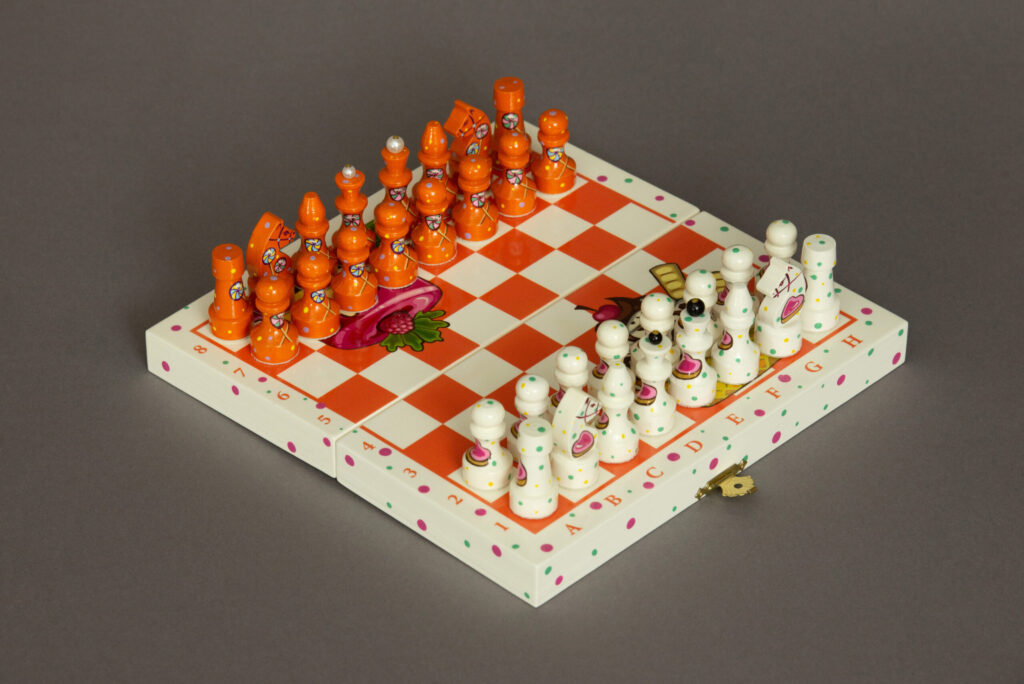
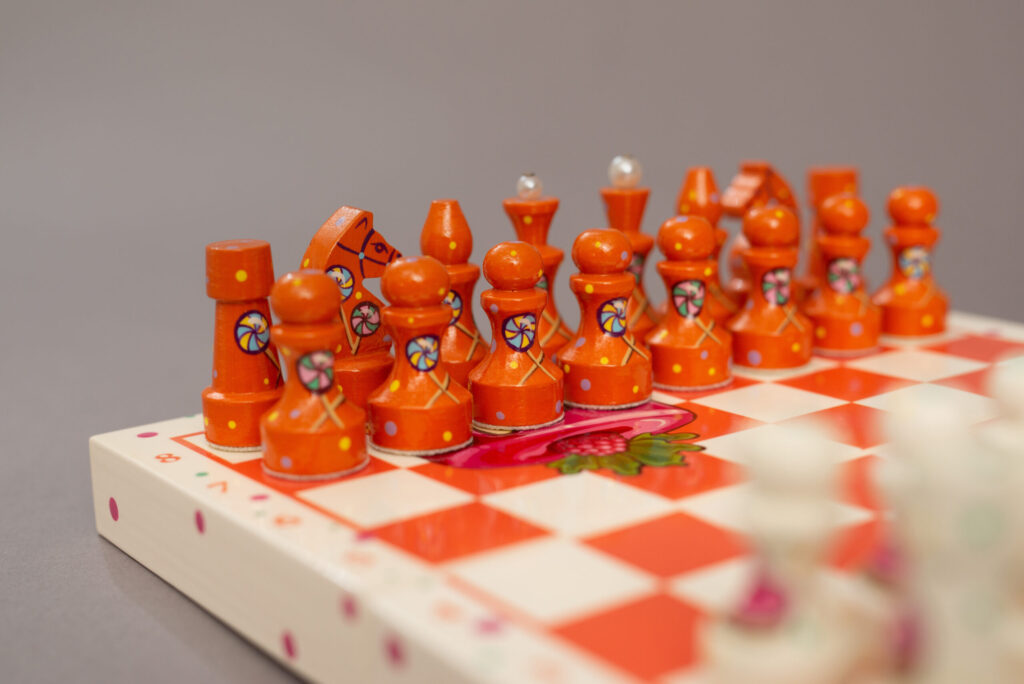
Dessert Chess Set
c. 2020
King size: 2 in.
Board: 15/16 x 9 x 9 in.
Pine and birch wood, acrylic paint, felt, and plastic
Collection of the World Chess Hall of Fame

What better way to celebrate the tenth anniversary of the World Chess Hall of Fame being in Saint Louis than a festive cake and ice cream-themed chess set? Chess Craft Trade House, which has been producing chess sets for nearly 90 years, created this set. The company, which began as a small cooperative of artists, today makes a wide variety of games, including chess, backgammon, and checkers. Some are decorated in traditional folk motifs, while others like this set, feature more contemporary themes.

August

August’s Featured Chess Set is part of the collection of the World Chess Hall of Fame (WCHOF). Since its creation in 1986, the WCHOF has endeavored to highlight the history and cultural significance of the game of chess. The WCHOF’s collection is diverse and includes sets once owned by legendary players, mass-produced sets with lively pop culture themes, antique ivory sets, travel sets, as well as chess computers. Through these artifacts, the WCHOF illustrates how chess has evolved through its over 1500-year history. This set is part of the museum’s permanent collection.

Heartland Publishing Services
Authors Chess Set
2007
King size: 4 in.
Board: 3 11/16 x 15 ⅛ x 17 in.
Resin, wood, and leather
Collection of the World Chess Hall of Fame

On August 10, 2021, Missouri will celebrate its bicentennial, and a number of organizations around the state will celebrate its culture and history. Missouri can boast a number of famous writers, among them Maya Angelou, T.S. Eliot, Laura Ingalls Wilder, Langston Hughes, and Tennesee Williams. However, in this chess set, Mark Twain reigns as king among a number of other 19th-century writers. Born Samuel Clemens in 1835, Twain’s childhood in Hannibal, Missouri, would provide him with material for two classic books—The Adventures of Tom Sawyer and The Adventures of Huckleberry Finn.

King: Mark Twain

Queen: Emily Dickenson

Bishops: Henry Wadsworth Longfellow

Knights: Edgar Allan Poe

Rooks: Walt Whitman

Pawns: Stack of books

July

July’s Featured Chess Set is part of the collection of the World Chess Hall of Fame (WCHOF). Since its creation in 1986, the WCHOF has endeavored to highlight the history and cultural significance of the game of chess. The WCHOF’s collection is diverse and includes sets once owned by legendary players, mass-produced sets with lively pop culture themes, antique ivory sets, travel sets, as well as chess computers. Through these artifacts, the WCHOF illustrates how chess has evolved through its over 1500-year history. This set is part of the museum’s permanent collection.

Jamie T. Cridge
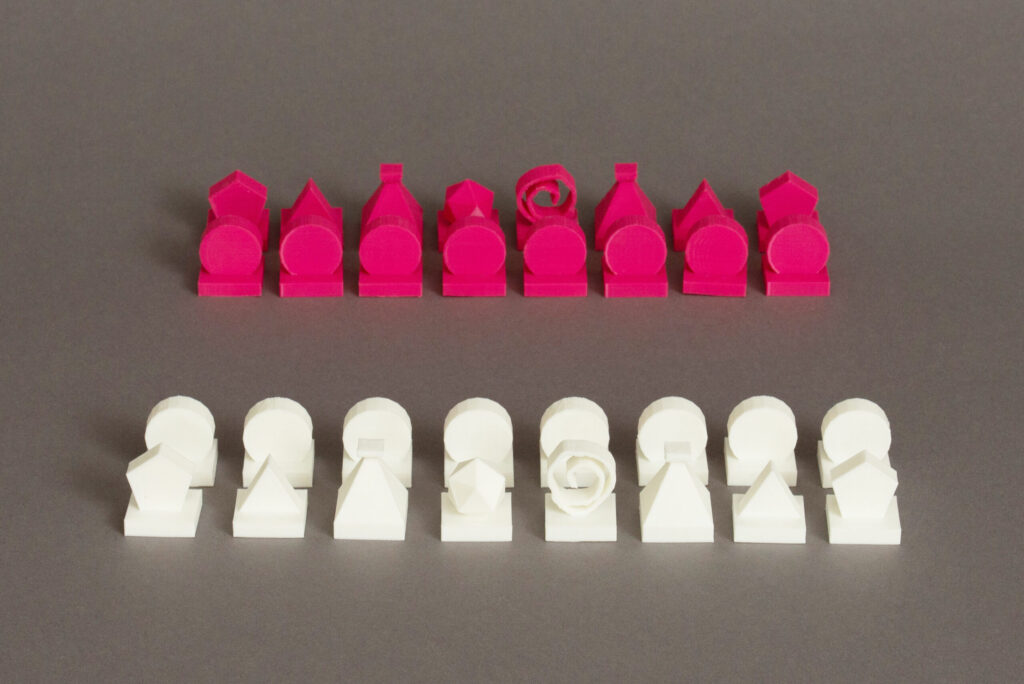
White vs. Pink Shapes
2021
King size: 1 5/16 in.
Board: ¾ x 13 ⅞ x 13 ⅞ in.
3D printed plastic
Collection of the World Chess Hall of Fame

If you could design your own chess set, how would you represent each of the pieces? In this creative set, high school student Jamie T. Cridge transforms the chess pieces into a variety of unusual shapes. As an aspiring engineer, she designed this set  to teach beginners the numerical value of each piece by making each piece a polygon with the number of sides correlating with the value of the piece.  For example, the one-point pawn is a circle, the three-point knight is a triangle, the five-point rook is a pentagon, and since the king is “priceless,” it is represented on the board as a swirl, an open polygon with no sides.  While this set is an excellent resource for beginners learning to play the game, experts will enjoy the set’s unique design as well.

June

June’s Featured Chess Set is on loan to the World Chess Hall of Fame from artist Erin King. King is a multidisciplinary artist working primarily in fiber-based processes. She is driven by the social responsibility of the individual as well as the strength and interconnectedness found in community. She received her Master’s of Fine Arts in Studio Art with an Emphasis in Fibers in May 2019. King was Fiber Artist-in-Residence at Craft Alliance in Saint Louis from July through December 2019. In addition to working as a Gallery Attendant at the World Chess Hall of Fame, she works as a Direct Support Professional at Fine Line Studios in Bridgeton, MO. She also teaches fiber art classes and workshops through Craft Alliance and Perennial St. Louis.

Erin King
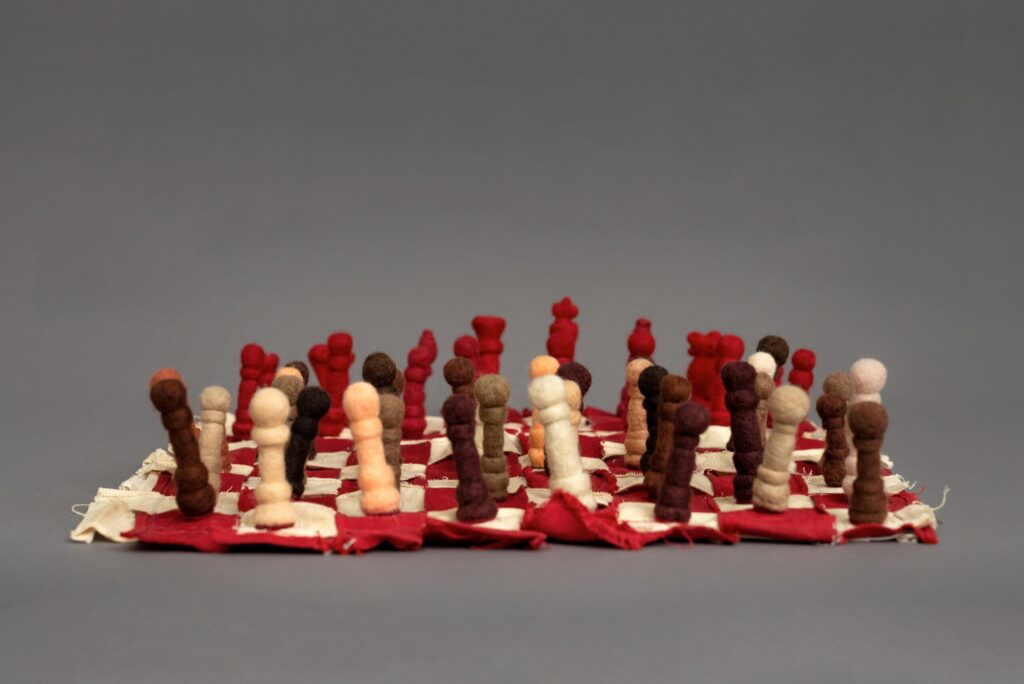
Freedom of Assembly
2020-21
King size: 3 ⅝ in.
Board: 18 x 18 ½ in.
Needle-felted wool roving, decommissioned U.S. flag, and magnets
Courtesy of the artist

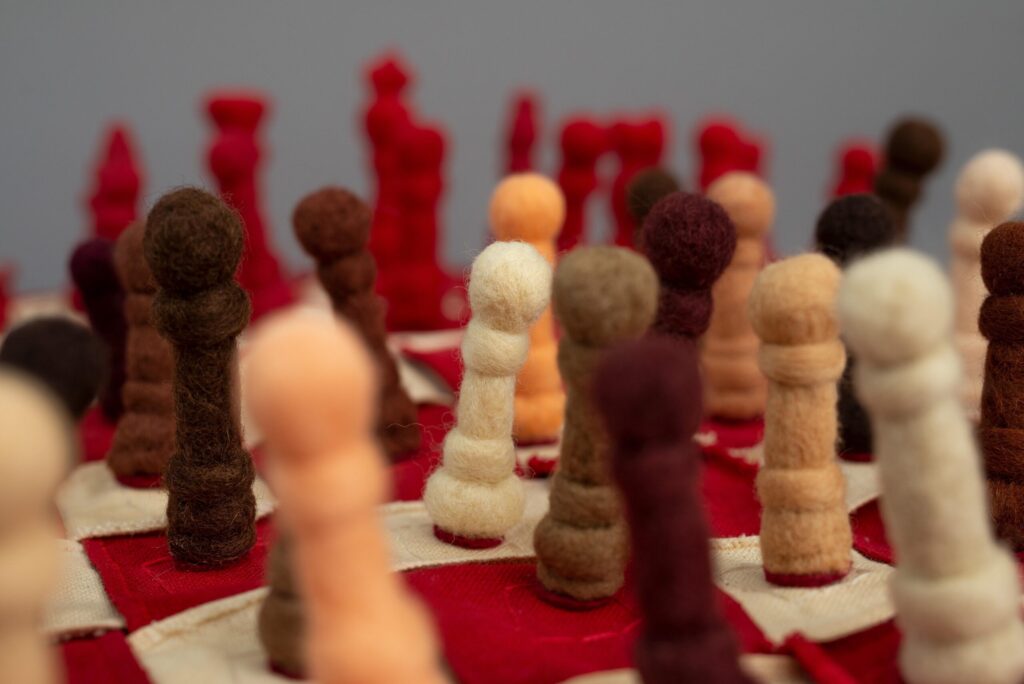
This chess set consists of 52 felt chess pieces and a red and white chess board woven from the stripes from a deconstructed retired U.S. Flag. The pieces on the board are arranged in a Horde chess variant, in which 36 pawns attempt to defeat the standard set with its powerful pieces. Inspiration for this piece comes from the months of nationwide and global protests that took place in 2020.
In Freedom of Assembly, the traditional use of black vs. white is subverted. Here, the “white” side, with its 36 pawns, are felted using a variety of skin tones and heights to bring humanity to the pawns. In doing so, the artist emphasizes that this battle is not one of black vs. white, but a case of unbalanced power as well as strength in numbers.

May

May’s Featured Chess Set is part of the collection of the World Chess Hall of Fame (WCHOF). Since its creation in 1986, the WCHOF has endeavored to highlight the history and cultural significance of the game of chess. The WCHOF’s collection is diverse and includes sets once owned by legendary players, mass-produced sets with lively pop culture themes, antique ivory sets, travel sets, as well as chess computers. Through these artifacts, the WCHOF illustrates how chess has evolved through its over 1500-year history. This set is part of the museum’s permanent collection.

World Chess Hall of Fame Supporters and Nette Robinson
Exploration Blend
2018
King size: 4 1/8 in.
Board: 21 5/8 x 21 5/8 in.
Boxwood, leather, acrylic paint, and lacquer
Collection of the World Chess Hall of Fame, gift of Purling London

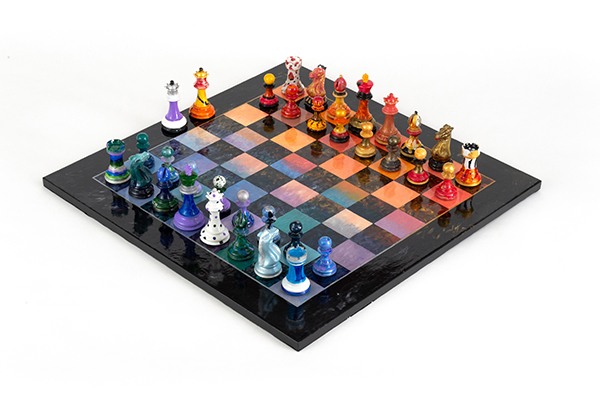
Exploration Blend was created by special supporters and friends of the World Chess Hall of Fame during a workshop led by artist Nette Robinson on August 23, 2018. The set, which is inspired by the theme of warm and cool colors, is accompanied by a board painted by Robinson. Each participant got to customize a chess piece. The event occured in conjunction with the World Chess Hall of Fame’s exhibition Painted Pieces: Art Chess from Purling London (April 12 – September 16, 2018).

April

April’s Featured Chess Set is part of the collection of the World Chess Hall of Fame (WCHOF). Since its creation in 1986, the WCHOF has endeavored to highlight the history and cultural significance of the game of chess. The WCHOF’s collection is diverse and includes sets once owned by legendary players, mass-produced sets with lively pop culture themes, antique ivory sets, travel sets, as well as chess computers. Through these artifacts, the WCHOF illustrates how chess has evolved through its over 1500-year history. This set is part of the museum’s permanent collection.

Maker unknown
Winnie the Pooh Chess Set
Date unknown
King size: 1 ½ in.
Board: 10 x 10 in.
Pewter, marble, and wood
Collection of the World Chess Hall of Fame

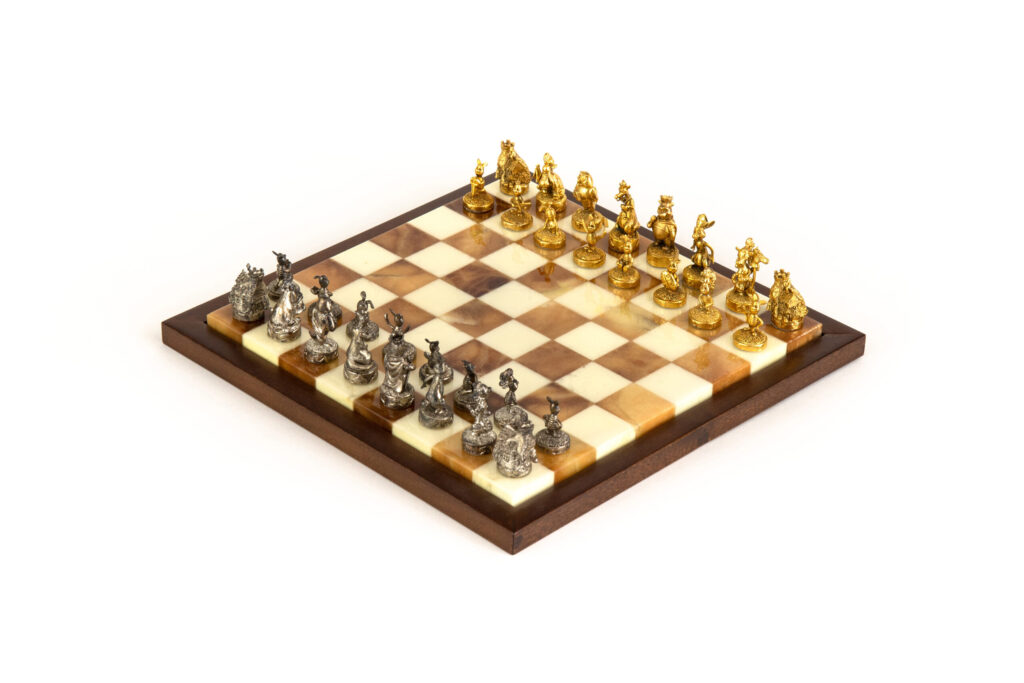
The inhabitants of the Hundred Acre Woods act as chess pieces in this nostalgic chess set. A.A. Milne’s legendary characters have sparked children’s imaginations for almost a century. In 1926, Milne wrote Winnie the Pooh, the first of many books telling the story of Pooh’s adventures in the Hundred Acre Woods. In this chess set, Pooh’s next adventure is a game of chess with his friends, including Piglet, Kanga, Roo, Owl, Eeyore, and Tigger.

March

March’s Featured Chess Set is part of the collection of the World Chess Hall of Fame (WCHOF). Since its creation in 1986, the WCHOF has endeavored to highlight the history and cultural significance of the game of chess. The WCHOF’s collection is diverse and includes sets once owned by legendary players, mass-produced sets with lively pop culture themes, antique ivory sets, travel sets, as well as chess computers. Through these artifacts, the WCHOF illustrates how chess has evolved through its over 1500-year history. This set is part of the museum’s permanent collection.

Maker unknown
Nautical Chess Set
Date unknown
King size: 4 in.
Wood
Collection of the World Chess Hall of Fame, gift of Bernice and Floyd Sarisohn

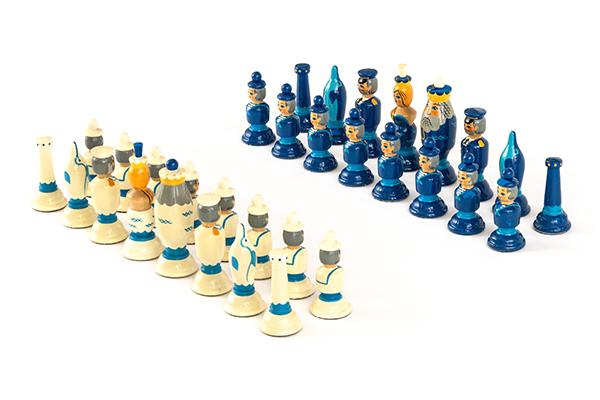
A game of chess with this set takes place at sea. The pawns are weathered sailors, obeying the orders of their captains, the bishops of the chessboard. Buoys are the rooks of this chess set, and dolphins play the role of the knight. The king of the chessboard is the Greek god of the sea, Poseidon, and his queen is an enigmatic mermaid. Bernice and Floyd Sarisohn kindly donated this nautical chess set to the World Chess Hall of Fame, adding to our collection of quirky and unique chess sets.

February

February’s Featured Chess Set is part of the collection of the World Chess Hall of Fame (WCHOF). Since its creation in 1986, the WCHOF has endeavored to highlight the history and cultural significance of the game of chess. The WCHOF’s collection is diverse and includes sets once owned by legendary players, mass-produced sets with lively pop culture themes, antique ivory sets, travel sets, as well as chess computers. Through these artifacts, the WCHOF illustrates how chess has evolved through its over 1500-year history. This set is a generous donation to the World Chess Hall of Fame from Nina Tsypina.

Nina Tsypina and Matvey Solovyev
Thimble Chess Set
Date unknown
King size: 2 ¾ in.
Metal, wood, and felt

Collection of the World Chess Hall of Fame, In memory of Matvey Solovyev, 1932-2020
This imaginative set features thimbles stacked, bent, and cut into the forms of chess pieces. Nina Tsypina and Matvey Solovyev created the set together. The couple immigrated to the United States from Moscow in 1996. While attending the Metropolitan Opera in New York, they saw an image of a chess set in the program, and they were inspired to create sets of their own, though they did not have backgrounds as artists. They often shopped for materials at toy stores. Together they made around 35 chess sets from materials as diverse as bells, dolls, and toothbrushes.

January

January’s Featured Chess Set is part of the collection of the World Chess Hall of Fame (WCHOF). Since its creation in 1986, the WCHOF has endeavored to highlight the history and cultural significance of the game of chess. The WCHOF’s collection is diverse and includes sets once owned by legendary players, mass-produced sets with lively pop culture themes, antique ivory sets, travel sets, as well as chess computers. Through these artifacts, the WCHOF illustrates how chess has evolved through its over 1500-year history. This set is part of the museum’s permanent collection.

Daniel Wilson
Rock vs. Country vs. Opera Chess Set
1984
King size: Rock: 6 ½ in.; Country: 6 ½ in.; Opera: 6 in.
Plaster
Collection of the World Chess Hall of Fame, gift of the family of Harvey and Teddi Robbins

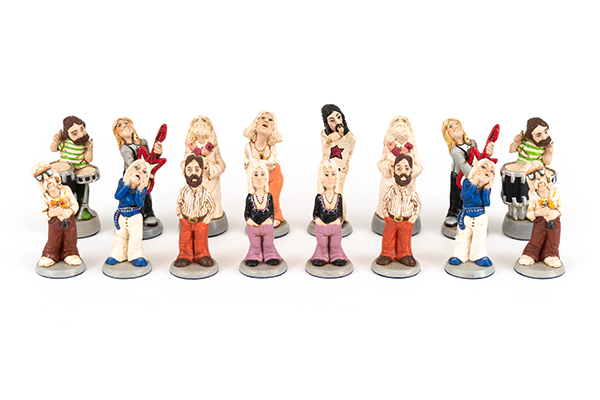
This dynamic chess set uses musicians from different genres of music to represent a three-sided chess game. The white pieces are made up of opera singers, sophisticated guests, and symphony musicians. Black represents cowboy hats, acoustic guitars, and southern twang––in other words, country music. Silver’s pieces are fans of rock ‘n’ roll, crooning their way across the board. Opera enthusiasts, die-hard country fans, and hippie rock ‘n’ rollers compete in this chess set full of musical references.

2020 Cairns Cup Exhibition

Organized for the second Cairns Cup, this exhibition contains highlights related to women’s chess from the collection of the World Chess Hall of Fame (WCHOF). Among the artifacts are objects related to important moments in women’s chess history, including Women’s World Chess Championships, Women’s Chess Olympiads, and many U.S. national championships held at the Saint Louis Chess Club (STLCC). Several of the artifacts are related to competitors in the tournament, including Grandmasters Valentina Gunina, Alexandra Kosteniuk, Irina Krush and Woman Grandmaster Carissa Yip.

Inspired by its mission to further promote the game of chess to women and girls, the STLCC created the Cairns Cup, a nine-round classical chess tournament that brings together one of the strongest international fields ever assembled in women’s chess with one of the largest prize funds for an all-female tournament. The tournament is named in honor of STLCC co-founder Dr. Jeanne Cairns Sinquefield, whose maiden name is Cairns. In addition to being the co-founder of the Club, Jeanne also played an instrumental role in creating the Scouts BSA Chess Merit Badge, which has been earned by over 170,000 scouts.

Artifacts Featured in the Exhibition

Lori Mattler of Lace Photography
Jeanne Sinquefield at the Scouts BSA Chess Merit Badge Launch
September 10, 2011
11 x 14 in., Photograph
Collection of the World Chess Hall of Fame
Lennart Ootes
Valentina Gunina, Winner of the 2019 Cairns Cup
2019
14 x 11 in., Photograph
Collection of the World Chess Hall of Fame
Justin Kellar
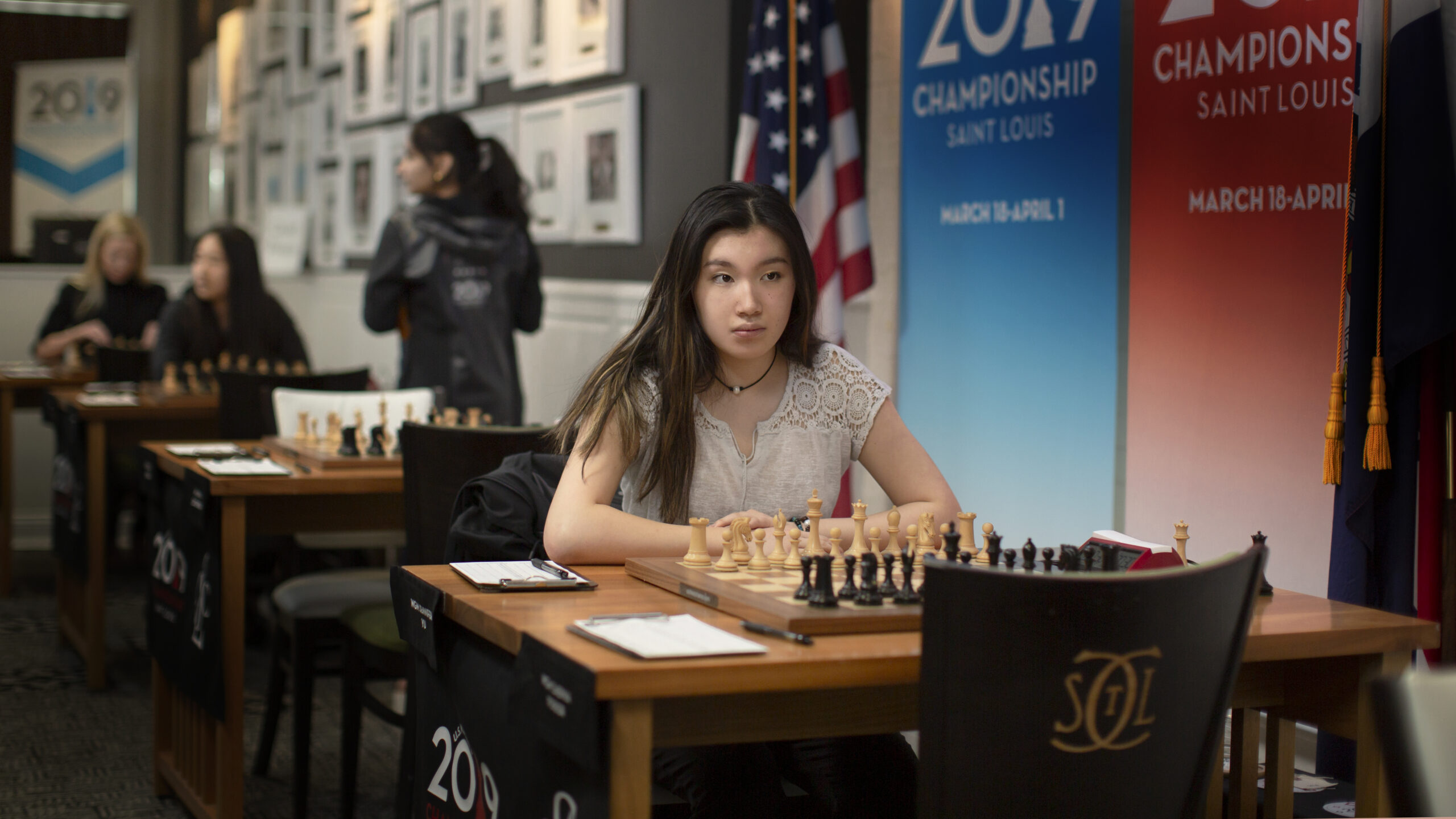
2019 U.S. Women’s Chess Championship Winner Jennifer Yu
2019
11 x 14 in., Photograph
Collection of the World Chess Hall of Fame
Crystal Fuller
Carissa Yip During Round 7 of the 2019 U.S. Girls’ Junior Chess Championship
July 18, 2019
11 x 14 in., Photograph
Collection of the Saint Louis Chess Club
Poster from the 1991 Women’s World Chess Championship Match, Manila, Philippines
September 25-November 2, 1991
20 ¾ x 14 ¾ in.
Paper
Collection of the World Chess Hall of Fame
Mark Rabkin
GM Maya Chiburdandize
Date unknown
7 ³⁄16 x 4 ¹¹⁄16 in.
Photograph
Collection of the World Chess Hall of Fame
Bill Hook
GM Xie Jun at the 1992 Chess Olympiad, Manila, Philippines
1992
6 x 4 in., Photograph
Collection of the World Chess Hall of Fame, gift of the U.S. Chess Center
Crystal Fuller
Valentina Gunina Before Round 5 of the 2019 Cairns Cup
2019
11 x 14 in., Photograph
Collection of the World Chess Hall of Fame
Spectrum Studios
GM Hou Yifan and GM Parimarjan Negi at the 2015 Showdown in Saint Louis
November 15, 2015
9 ½ x 14 in., Photograph
Collection of the World Chess Hall of Fame
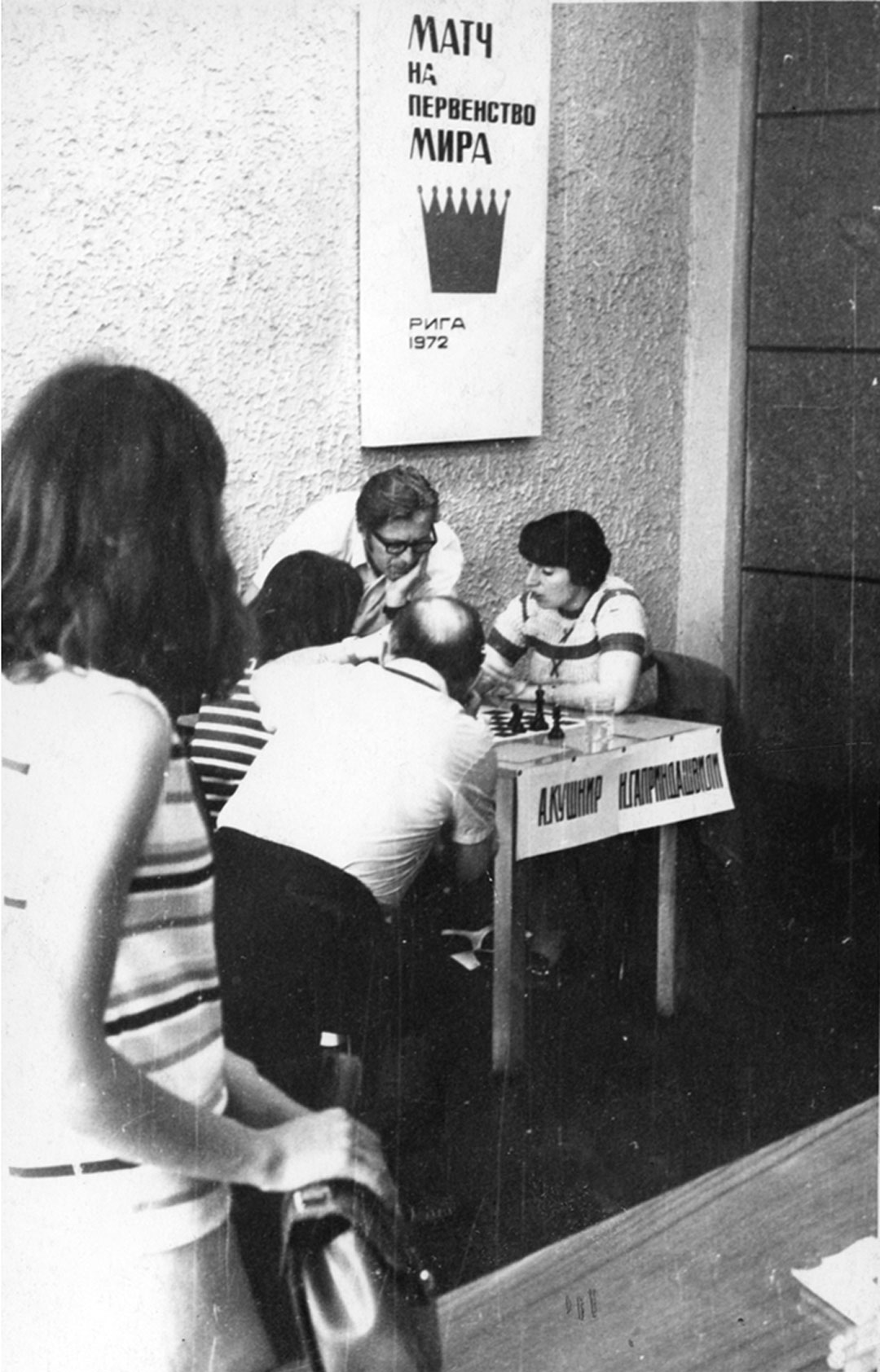
Photographer unknown
GM Nona Gaprindashvili and WGM Alla Kushnir at the 1972 Women’s World Chess Championship, Riga, Latvia
1972
5 ½ x 3 ⅝ in., Photograph
Collection of the World Chess Hall of Fame
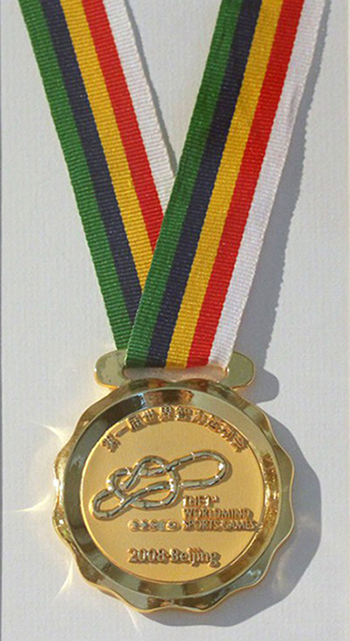
GM Alexandra Kosteniuk’s Gold Medal from the 2008 Mind Sports Games, Beijing, China
2008
2 ¾ in. diameter, Metal and cloth
Collection of the World Chess Hall of Fame
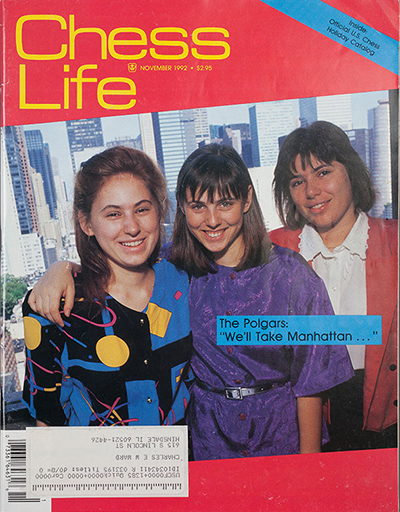
Chess Life, Vol. 47, No. 11
November 1992
10 ¾ x 8 ¼ in., Paper
Collection of the World Chess Hall of Fame, gift of Bill Merrell
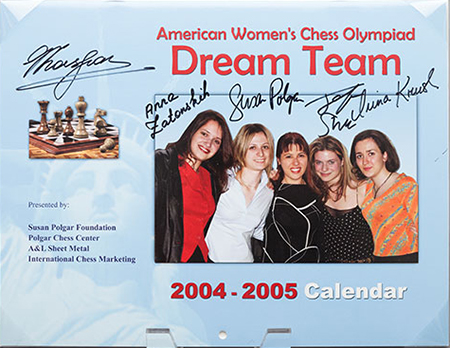
Dream Team Calendar from the 2004 Chess Olympiad, Calvià, Majorca, Spain
2004
8 ½ x 11 in., Paper
Collection of the World Chess Hall of Fame, gift of John Donaldson
Austin Fuller
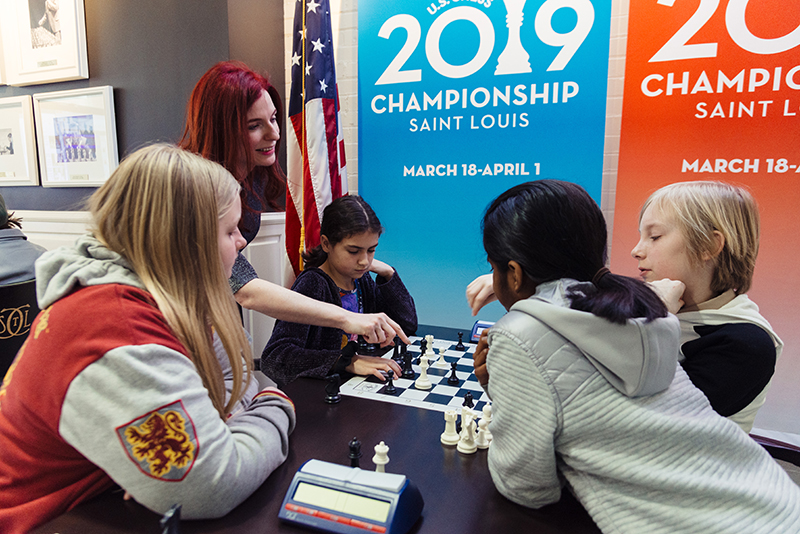
Scouts BSA Girls Merit Badge/Cairns Cup Community Day
February 3, 2019
8 x 10 in., Photograph
Collection of the World Chess Hall of Fame
Lennart Ootes
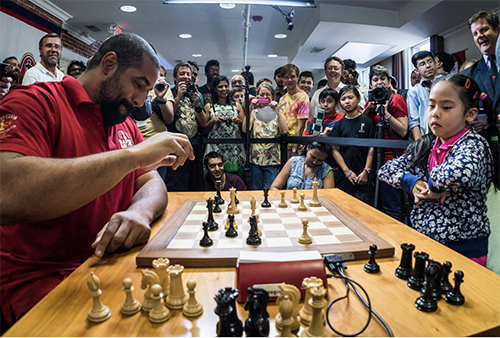
John Urschel vs. Rachael Li at the 2017 Ultimate Moves Match
August 19, 2017
9 ½ x 14 in., Photograph
Collection of the World Chess Hall of Fame
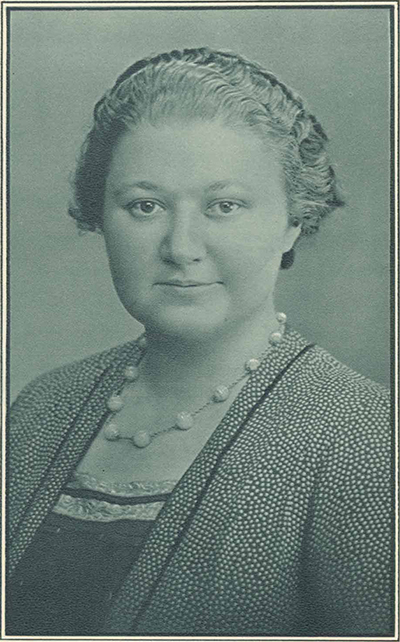
Studio Herbert Vandyk, Londres.
Vera Menchik, from Le Monde des Echecs
February 1933
9 ½ x 6 ¼ in., Paper
Collection of the World Chess Hall of Fame, gift of John Donaldson
Sports Illustrated, Vol. 15, No. 6
August 7, 1961
11 x 8 ½ in., Paper
Collection of the World Chess Hall of Fame
Poster from the Sixth Women’s Chess Olympiad, Medellin, Colombia
September 15 – October 7, 1974
19 ⅝ x 27 ¾ in., Paper
Collection of the World Chess Hall of Fame

Power in Check: Chess and the American Presidency

Power in Check: Chess and the American Presidency showcases a variety of politically-themed chess sets from the World Chess Hall of Fame’s permanent collection. This redux of 2012’s exhibition offers a look at how the “royal game” of chess has fascinated American presidents for over 200 years.

Chess has influenced the American presidency since the administration of George Washington. While a game replete with Kings and Queens might at first seem antithetical to democratic leadership, commanders-in-chief have continually appreciated chess’ practical benefits and cultural significance, playing to escape the pressures of a stressful job, hosting successful players from around the world, and utilizing the game as a metaphor for larger national and international issues.

Dare to Know: Chess in the Age of Reason

Dare to Know: Chess in the Age of Reason showcases numerous chess sets, books, artwork, and other artifacts representing Enlightenment centers in Europe and the United States. Chess sets belonging to famous historical figures from the era, including Catherine the Great and Madame Tussaud, will be on view alongside humble playing sets and a display related to the “Mechanical Turk,” a famed chess-playing automaton.

Dare to Know: Chess in the Age of Reason

During the Enlightenment era, European and American scientists, philosophers, and other thinkers questioned the status quo, promoting ideas that would help shape today’s society.  Intellectuals gathered in new public spaces–cafes, coffee shops, salons, and masonic halls–to discuss new ideas. Some dared to challenge the power of monarchs and question organized religion. Many thinkers promoted values of tolerance, interest in other cultures, rationalism, and liberty. At the same time that there were challenges to the monarchy, chess was transforming from a game played by the aristocracy to one played by people of all social standings. Dare to Know: Chess in the Age of Reason explores the history of the game during this period of remarkable change.

Chess, which was knowledge, foresight, and strategy, naturally became a favored pastime of many of the era’s most famous thinkers, including Voltaire, Denis Diderot, and Jean-Jacques Rousseau in France. They took part in the lively social scene that existed in coffee shops such as the legendary Café de la Régence, a renowned chess mecca that attracted philosophes and the best chess players of the era, including François-André Danican Philidor. Dare to Know: Chess in the Age of Reason showcases chess sets, books, artworks, and other artifacts hailing from Enlightenment centers in Europe and what was to become the United States.

Curated by Emily Allred, Curator, World Chess Hall of Fame, with Tom Gallegos