
Exhibition Archives - Page 5 of 10 - World Chess Hall of Fame & Galleries

Universal Turf: Peter Manion

Universal Turf: Peter Manion is a mixed media installation of never-before-seen works by Saint Louis-based artist Peter Manion that explores social and interpersonal parallels between chess and humanity. Manion’s plaster-coated panels of dyed felt create an interactive environment in which visitors are encouraged to interact with parts of the installation.

Universal Turf: Peter Manion

I met Peter Manion about 10 years ago, soon after I moved to Saint Louis. I was always impressed with his artwork, his creativity, and his interest in experimenting with different media. Little did I know, that in addition to his proclivity for art, he also had a deep interest in chess. Peter came to the World Chess Hall of Fame (WCHOF) shortly after we opened in 2011 with an old, rugged-looking Milton Bradley chess “game.” This was no ordinary cardboard or wooden board with simple, cheap, plastic pieces—this was a machine! He carried the Milton Bradley Electronic Grand·Master, first sold in the early 1980s, up to our offices and still had the actual original cord. I stared in disbelief, not only surprised that something like this existed, but also that he could actually plug it in and it would still work. We found an outlet, he plugged it in and it came to life. The box claims that it “Moves its Own Pieces Automatically and Brilliantly!—for 1-or 2-players.” He set up the pieces and began pushing buttons that had looked like they had been pushed 1000 times before. Immediately, loud creaking noises came from within the machine and the chess pieces began shaking, stuttering, and moving across the chessboard. I was amazed by the mechanism, and as he smiled watching it work, I thought that Peter might be relieved to rid his home of this old toy, not realizing that years later we would be having a very emotional conversation about what that game meant to him as a child and later as an adult.

In March 2017, the WCHOF opened the exhibition The Imagery of Chess: Saint Louis Artists. This was directly inspired by the groundbreaking 1944 exhibition, The Imagery of Chess at the Julien Levy Gallery in New York City. Organized by Marcel Duchamp, Julien Levy, and Max Ernst, the original show included the work of over 30 painters, photographers, sculptors, critics, and composers, among others and sought to challenge the accepted conventions of the ancient game. The highly-publicized exhibition was well received by the chess, art, and general communities, and the project went on to inspire artists over the last 70+ years to reinterpret the game in an artistic way and became the basis of the artistic programming at the WCHOF.

Our contemporary exhibition featured 20 leading local artists, writers, designers, musicians, and composers and their newly-commissioned artwork and performances inspired by the game of chess. Not only did Peter exhibit in the show, he also assisted me with selecting several of the artists in the exhibition and added to its success. This new exhibition was so inspiring because it celebrated the impact of chess culture in Saint Louis and promoted local artistic talent. I knew immediately that the WCHOF needed to create more local artistic programming and exhibitions.

Universal Turf: Peter Manion debuts this new wave of regional artist exhibitions at the World Chess Hall of Fame. With a mission to celebrate the history of the game, we strive to make everyone feel welcome here, whether you’re a grandmaster or you have never picked up a chess piece before. Universal Turf is not just an art exhibition, but rather it is an immersive environment that begs the viewer to engage with a series of sculptures and installations and become lost in an endless interpretation of the universe, of time, of space. Peter doesn’t use typical artists’ supplies; rather, inspired by his earlier career as a house contractor, he uses thick felt, plaster, paint, and dyes to create movable, beat-up, crumpled, living pieces of art. Because he is constantly manipulating the pieces, they will never look the same twice—there are an infinite possible ways his work can be exhibited similar to the infinite possible moves in a chess game.

Peter Manion, AYE, 2018
AYE, 2018

According to Peter:

“As the viewer enters the gallery, the first image is simple and appears to be a blank canvas. This is an exercise in nothingness. However, these works are about looking closer and studying, just as in a game of chess. Take a moment to let your imagination wander. Composed of black plaster on black felt, this is the single largest piece I have ever made.

To the right, you are confronted with an array of small, colorful sculptures made of the same materials, but they are completely different in scale. Viewing these works you think, are they fixed sculptures? Solid or hollow? Heavy or lightweight? The surface texture gives the appearance of weight.

Mixed media works on paper on the wall were created in a sketchbook approach. Forget the composition, the purpose, or logic—they are to show my thought process, working out ideas past and future. The shapes are semi-attached sheets of vinyl that can and may fall off. The primary colors are the basis for all of the colors we see. They are elemental colors.

Opposite the sketches are human-scale, colorless works. Composed of white plaster over colored felt, they are formed and pushed to create monumental, stiff sculptures. Though they appear immovable, they are in fact flexible and ready to fall from the slightest disturbance. These works exemplify the transformation from painting to sculpture and show that the works trigger more questions than answers.

In the main room is the largest piece—both an installation and a  performance, it is alive and can and will change, testing the idea of what is the meaning of art—is it to tell the story of the artist or the story of the viewer?”

Though one may not see a perfect chessboard or an array of Staunton chess pieces, by studying and meditating on these works, our hope is that the viewers will engage with the pieces and possibly get a glimpse into the mind of a chess player—plotting future moves, reflecting on past ones, taking a moment to slow down and think and wonder if you are seeing what everyone else is seeing? Are you focusing on the big picture or the tiny details? Are you thinking before reacting? Are you moving automatically and brilliantly?

—Shannon Bailey, Chief Curator, World Chess Hall of Fame

Peter Manion, Elementals, 2018
Elementals, 2018
Peter Manion in the Studio, 2018

Process & Movement: the Studio of Peter Manion

Spend an hour in the studio with Peter Manion, and you’ll learn that it is an understatement to call his artistic practice process-driven. Plastering, spraying, moving, manipulating—ultimately creating—his sculptures are tests of endurance, patience, and learning to let go.

Though his finished works appear to be thin and ephemeral, each piece can weigh as much as 100 pounds and requires the assistance of several people to carry. In the studio, Peter becomes one with his art. He crawls along the walls, climbs over and atop the pieces, jumps, and hurls the work when needed, working to create a proper balance of adhesion and protrusion. It is an example of action art at its finest. It’s mesmerizing and energizing. There’s a primal nature in how he utilizes his entire body to create.

Peter works to coax the materials, but ultimately allows them to behave as they wish. In this, he could be called a facilitator, rather than a creator.

“Art is a moment in time—a feeling, an emotion, an energy. The law of conservation of energy greatly influences my work, and I consider that, just as there is this cycle of energy, this creation and deterioration of all matter, my artwork is not removed from this cycle. My energy transfers to my work as it’s made, continuing the phenomena of senescence and entropy that is a law of all things in nature.”

This cycle—of energy of creation, transformation, and decay—is palpable. Within that hour of sitting in Peter’s studio, a piece so perfectly formed may fall without notice. Other works, as they’re handled and repositioned over and over again, become soft and deteriorate, losing their form. Just as time is fleeting, so are the moments in Peter Manion’s art.

—Jessica Mannisi, Independent Curator

Peter Manion, End of Something, 2018
End of Something, 2018

Self-Infliction

I remember the room where it was placed. Glass table, two chairs—it sat lower than it should have been. It stood in front of a window that looked onto the yard and the brown graveled street. I sat there for many hours—after school, on weekend mornings, and late afternoons. Alone.

My mother bought me a chessboard that I could play without an actual human; it was all computerized. She didn’t want me to go outside to play with other kids because she said it was “Hoosier.” My mother wanted my pursuits to be more intellectual. That was never my strong suit, but I did fall in love with playing chess.

The time alone, without really understanding it, made me more connected to myself. I daydreamed as I played. I imagined the pieces and the game as a battle being waged and that there were life and death consequences for the pawn that was captured. I tried and tried to beat the computer. Level one was easy enough; two and three were breakthroughs; four was my threshold. Patience was my weapon.

As I reflect on it now, I believe that my early relationship with chess led me directly to this exhibition. It wasn’t the winning or losing, the pieces and rules—it was the way it changed my way of thinking. I was purposeful and dedicated, experimental and stubborn, and flexible and determined. All of these attributes have precipitated the work I have made. It’s work that is all of those things—and sometimes it feels like I’m playing chess with these works. As fleeting as the feeling of winning or losing is, so is the way of these works. They are one thing at one moment—with beauty and purpose—and in the next moment, they are nothing and just a thing. But you push forward. You try to win again. To find the right combinations of moves—and that perfect moment.

What I know is that those early years in particular changed me and playing chess alone was a formative experience. Some might say that seems sad, but during my childhood it was at times the only place I found peace and solace.

—Peter Manion

Peter Manion, Universal Turf, 2018
Universal Turf, 2018
Peter Manion, Make Your Move, 2018
Make Your Move, 2018

Peter Manion

Saint Louis-based artist Peter Manion received his Bachelor of Fine Arts from the School of the Art Institute of Chicago. Manion’s works hint at his background in drawing, and his emphatic strokes and subject matter offset a playful use of material, style, and sense of humor.

Manion’s use of non-traditional methods, materials, and practices gives his work an animative quality, lending variance and movement to what once was undisturbed, bringing the work closer to the idea of a living object.

Manion has been the recipient of multiple awards, including an Award of Excellence at Art Saint Louis and the Judge’s Award of Merit at Kranzberg Arts Center, in addition to several recent exhibitions: La Fragua to Vermont: Works on Paper at Houska Gallery, Saint Louis; Imagery of Chess: Saint Louis Artists at the World Chess Hall of Fame, Saint Louis; and En La Noche, El Convento de Santa Clara de la Columna del Siglo XV, Belalcazar, Spain.

Jessica Mannisi

Jessica Mannisi is an independent curator, curatorial consultant, and art historian with over 10 years of experience in the museum and gallery field. Working closely with regional, national, and international artists, she’s been involved in a number of award-winning exhibitions and projects.

She is the art director of Houska Gallery in the Central West End, co-founder and curator of the pop-up South City studio gallery Macklind Appliance, and the assistant curator of visual art at Angad Arts Hotel in Grand Center. Mannisi is active in supporting Saint Louis-regional arts, working with several award-winning artists to elevate the local arts community. Mannisi worked as an advisor with Peter Manion on this exhibition.

Universal Turf Interactive Area
Peter Manion, ¿Cuando Tú Castillo No Es Nada?, 2018
¿Cuando Tú Castillo No Es Nada?, 2018
Financial assistance has been provided by the Missouri Arts Council, a state agency.

Photography by Michael DeFilippo.

Press

2/6/2019: Silver Space — Life In Plaster

1/31/2019: HEC-TV — Peter Manion & Harry Benson at the World Chess Hall of Fame (video)

10/3/2018: FOX 2 — Chess Hall of Fame Art Exhibit (video)

9/27/2018: Business Insider — World-Renowned Photography and Contemporary Art Exhibits to Open at the World Chess Hall of Fame in Saint Louis this October

9/27/2018: Press Release — Universal Turf: Peter Manion

Kings, Queens & Castles: Summer Satellite

Thanks to a special partnership with the Jennings School District, The Magic House, St. Louis Children’s Museum and the World Chess Hall of Fame, families can enjoy our Kings, Queens & Castles exhibit in the summer of 2018—free of charge!

This innovative children’s chess exhibit was co-created by The Magic House and the World Chess Hall of Fame and brings the game of chess to life while providing an engaging introduction to individual chess pieces and game strategy.

Families can enjoy free play in the exhibit as they walk across a drawbridge into a medieval castle complete with turret slides and learn how to prepare for a game by arranging a giant chess board with large-scale pieces, don a royal cape and sit on a majestic throne to become a king or queen, use their creativity to make a fanciful crown and shield and enjoy a game of chess.

Golf the Galleries: Artist-Designed Mini Golf

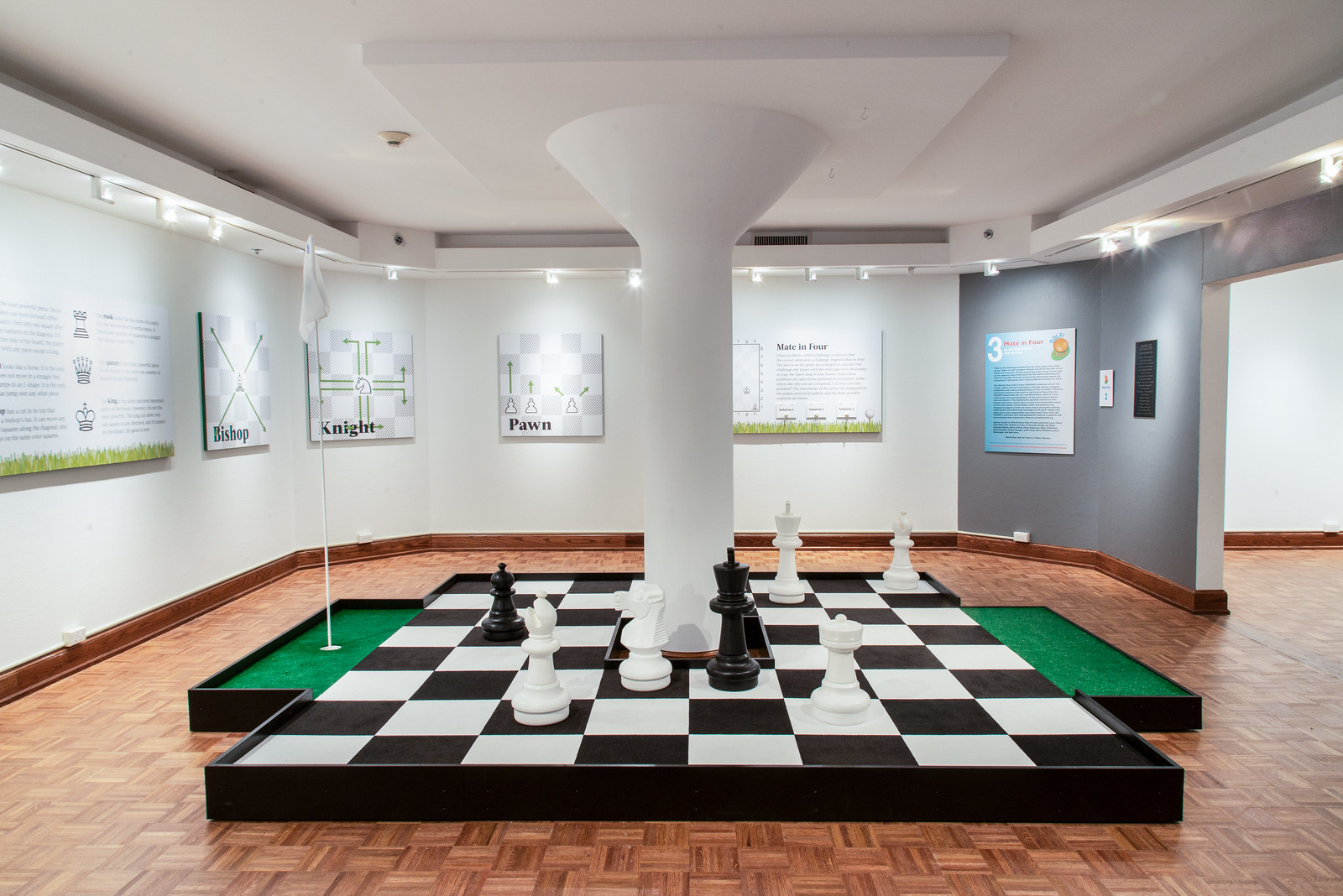
The World Chess Hall of Fame is proud to be a maker and sponsor in The Sheldon Art Galleries’ newest exhibition, Golf the Galleries: Artist-Designed Mini Golf, on view June 1 through August 12, 2018.

The Sheldon Art Galleries presents a unique interactive art exhibit—a nine-hole playable, family-friendly mini golf installation that takes over their entire 2nd floor gallery space.

Our chess-themed hole titled “Mate in Four” presents a challenge by not only the obstacles of the chess pieces themselves, but also through a strategic chess problem integrated into its design. Players tee off on one side of the board and maneuver the ball around the pieces to get to the hole on the opposite side.

Golf the Galleries 2018

For more information, visit www.thesheldon.org.

Press

6/8/2018: St. Louis Public Radio — ‘Putt your way through downtown St. Louis’ at Sheldon Art Galleries’ mini-golf installation

6/5/2018: KPLR — Golf course makes for fun at Sheldon Art Galleries

6/1/2018: St. Louis Magazine — You can mini golf at the Sheldon Art Galleries this summer

6/1/2018: HEC TV — Putt-putt what? Artists design holes for a gallery-worthy mini-golf course

5/31/2018: KMOV — Exploring the new artistic mini golf course

5/24/2018: Ladue News — Putt-Putt Goes Picasso

5/23/2018: KSDK — Play Mini Golf this summer at The Sheldon Art Galleries

Capturing Imagination: Pop Culture and Chess

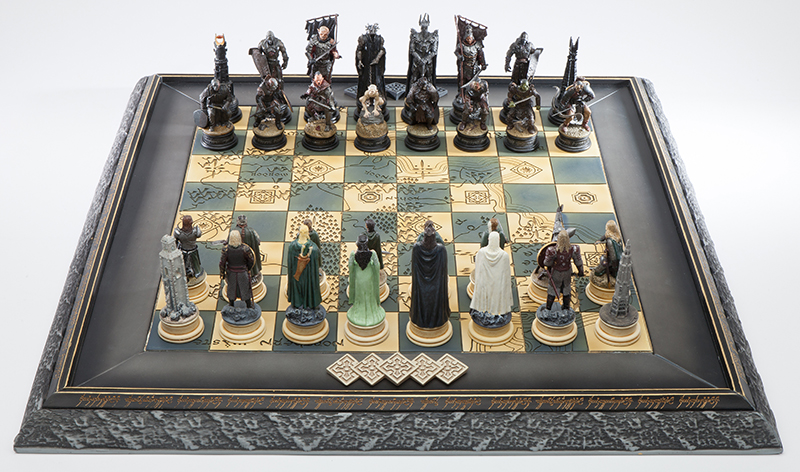
Capturing Imagination: Pop Culture and Chess showcases 16 popular culture-inspired chess sets and related artifacts from the collection of the World Chess Hall of Fame (WCHOF). With characters from fictional locations as varied as the fantastical land of Middle-earth and the prehistoric town of Bedrock, the sets show how creators have reinterpreted the game’s familiar pieces. Chess, with its two opposing sides and iconic pieces, lends itself well to telling stories about good and evil, as in the Marvel Characters set on view here. However, many of the others simply offer a chance to see beloved characters as royalty or pawns.

Objects Featured in the Exhibition

Muppets don the costumes of kings and queens in this pair of humorous sets. Created by Jim Henson in 1955, the Muppets are a group of puppets that have appeared in television, films, and advertisements. In 1969, Joan Gaenz of the Children’s Television workshop invited Henson to collaborate on Sesame Street, a show blending education and entertainment. He created some of the show’s most iconic characters, including Big Bird, Oscar the Grouch, Bert and Ernie, and Cookie Monster, all of whom appear in this chess set celebrating the show’s 35th anniversary.

Seven years after working on Sesame Street, Henson produced The Muppet Show. Featuring a wacky cast of Muppets led by showrunner Kermit the Frog, the series showed a vaudeville or variety show, featuring song and dance, skits, and glimpses of backstage antics by beloved characters such as Gonzo, Animal, Miss Piggy, and Scooter. The show also famously featured appearances by celebrities including Mark Hamill, Harry Belafonte, Elton John, Rita Moreno, and Lena Horne. It aired for five seasons with a total of 120 episodes from September 13, 1976, to March 15, 1981, on CBS.

The Marvel Characters Chess Set depicts an epic clash between good and evil featuring some of the best-known characters in the Marvel Comics universe. In 1963, Marvel introduced the Avengers, a team of superheroes that fights supervillains too tough for one hero to battle alone. The founding members of the team included characters created by Stan Lee and Jack Kirby: Thor, Iron Man, Ant-Man, Wasp, and the Hulk, some of whom are present in this chess set. Since the comic’s introduction, the team’s lineup has changed dramatically, sometimes growing to include a number of new heroes as well as gaining a new lineup when the previous Avengers are killed off or disbanded. A film inspired by the series, Avengers: Infinity War premiered on April 27, 2018.

Lord of the Rings Chess Set, 2012
Eaglemoss
Lord of the Rings Chess Set
2012 
Lead pieces and plastic board
© MMVII New Line Productions, Inc.

Three classic works of literature are transported to the chess board in this trio of sets. A map of Middle-earth is laid over the board in the Lord of the Rings Chess Set. The set is inspired by the film adaptations of The Lord of the Rings (1937-1949), a series of fantasy novels written by English author J.R.R. Tolkien. The story follows Frodo, a hobbit, as he and his companions seek to destroy the One Ring, which would allow the evil Sauron to enslave Middle-earth.

The other two literary tales interpreted in this case feature more lighthearted children’s stories: that of Babar the Elephant and Winnie the Pooh. Babar debuted in 1931 in Histoire de Babar by Jean de Brunhoff. It tells the story of an orphaned elephant who goes on to become a king. In this playful set, Babar and his court are opposed to that of Lord Rataxes, a rhino ruler.

Histoire de Babar was translated into English by A.A. Milne, the author of Winnie-the-Pooh (1926), the third literary work on view in this case. Winnie the Pooh, a bear, and his friends, who appear here as the pieces, were modeled upon toys owned by Milne’s son.

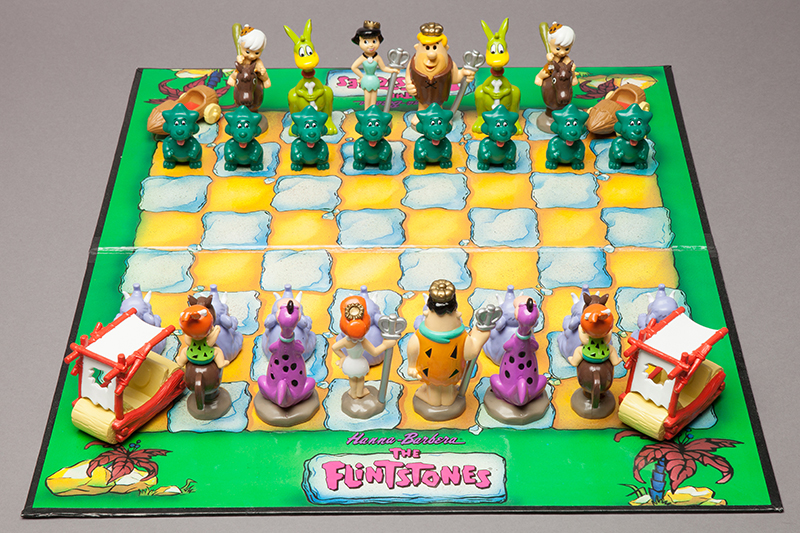
Flintstones 3-D Chess, 1993
Wood Expressions Inc.
The Flintstones 3-D Chess
1993
PVC pieces and cardboard board
© & ™ Hanna Barbera Productions Inc.

Bart Simpson Sore Loser No. 56

This pair of sets depicts two of the most famous families in animation: the Flintstones and the Simpsons. The Flintstones, the first animated primetime sitcom, premiered September 30, 1960, and was produced by Hanna-Barbera. The show followed the Flintstone and Rubble families, who make up the two sides of this set. Until The Simpsons surpassed The Flintstones, the show held the record for the longest-running primetime animated series with 166 episodes.

Created by Matt Groening, The Simpsons, which follows the adventures of the dysfunctional titular family, premiered on December 17, 1989. The show takes place in a fictional town called Springfield and makes constant pop cultural references parodying the middle-class American lifestyle. The set is accompanied by a board that depicts many of the supporting characters from their hometown of Springfield as well as two Simpsons comics with chess-themed covers.

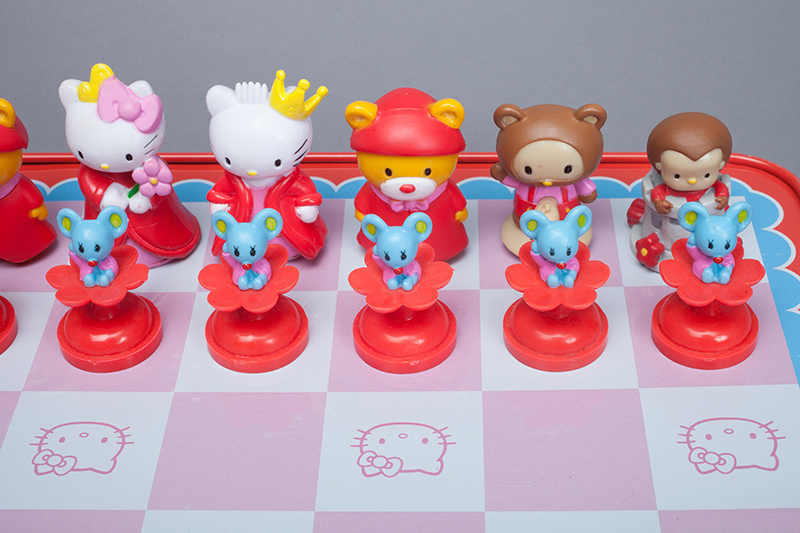
Sababa Toys/Sanrio, Hello Kitty Chess Game in Deluxe Collector Tin, 2004
Sababa Toys
Sanrio
Hello Kitty Chess Game in Deluxe Collector Tin
2004
King size: 2 in.
Board: 3 5/16 x 12 x 12 in.
PVC pieces and tin board
Collection of the World Chess Hall of Fame
©1976, 2004 Sanrio Co., Ltd.

Two well-loved cartoon characters and their friends appear in these sets. Charlie Brown and the “Peanuts gang,” who appeared in Charles Schulz’s long-running Peanuts comic strip, are a humorous version of the pieces in this set.

Made in honor of Hello Kitty’s 30th anniversary, the set on the right features the titular character and her friends as adorable pieces, complete with rocking horse knights that actually wobble. Designer Yuko Yamaguchi created Hello Kitty in 1974. The character soon appeared on a wide variety of consumer projects, but her popularity exploded in the 1980s, when Sanrio made a concerted effort to adapt her appearance to market to older children.

Star Trek Rules for Tri-D Chess, 1976
Paradise Press
Star Trek: Rules for Tri-D Chess, Voyage Fourteen
1976
© Paramount Pictures
Star Trek Chess Set, 1976
The Franklin Mint
The Official Star Trek Tridimensional Chess Set
1994
Sterling silver, 24 karat gold, and plastic
© Paramount Pictures

Even in stories set far away from Earth, chess, one of the world’s oldest and best-known games appears. This pair of chess sets are inspired by two beloved series set in space, one in the distant past and another in the future: Star Wars and Star Trek. Created by George Lucas, Star Wars debuted in 1977. Inspired by the original Star Wars trilogy, the first set pits the Jedi against the Sith and includes some of its most memorable characters including Luke Skywalker, Princess Leia, Han Solo, and of course, Darth Vader.

The second set and book are inspired by tridimensional chess, a complex version of the game that was introduced in Star Trek: The Original Series, which followed the crew of the U.S.S. Enterprise. Star Trek is an American science fiction television series created by Gene Roddenberry in 1966, which has since become a franchise with multiple series and movies. Chess appears in many of the subsequent series, including Star Trek: The Next Generation and Star Trek: Deep Space Nine.

Featured Chess Sets 2018

Through the Featured Chess Set project, the World Chess Hall of Fame showcases a variety of chess sets throughout the year. These include highlights from the institution’s collection as well as chess sets owned by Saint Louis metropolitan area friends and chess lovers who have special stories to accompany their sets.

Do you live in the Saint Louis metropolitan area and have a chess set with a great story? Submit it for inclusion in our Featured Chess Set project! This program highlights chess sets with interesting backgrounds borrowed from chess lovers and fans of the Hall of Fame. Featured chess sets are displayed for a period of one month at the World Chess Hall of Fame.

If you would like to participate in the program, send a photo and the story of the set to Emily Allred, Assistant Curator, at [email protected].

January

January’s Featured Chess Set is part of the collection of the World Chess Hall of Fame (WCHOF). Since its creation in 1986, the WCHOF has endeavored to highlight the history and cultural significance of the game of chess. The WCHOF’s collection is diverse and includes sets once owned by legendary players, mass-produced sets with lively pop culture themes, antique ivory sets, travel sets, as well as chess computers. Through these artifacts, the WCHOF illustrates how chess has evolved through its over 1500-year history.

NHL Collectors Edition Chess Set, 2003

USAopoly

NHL Collectors Edition Chess Set

2003

King size: 3 3⁄16 in.

Board: 20 x 14 7⁄8 in.

Plastic and cardboard

Collection of the World Chess Hall of Fame

In the NHL Collectors Edition Chess Set, a hockey rink serves as the board for a unique chess set depicting hockey players, coaches, and referees. The set celebrates the National Hockey League (NHL), which was founded in 1917. At the time of its founding, the league only had five teams, but has since expanded to 31. Saint Louis, the location of the World Chess Hall of Fame (WCHOF), gained the Blues in 1967, when the league embarked on the largest expansion in the history of professional sports, doubling the number of teams from six to 12. In 1994, hockey became the official winter sport of Canada. This is one of a number of sports-themed chess sets in the collection of the WCHOF.

February

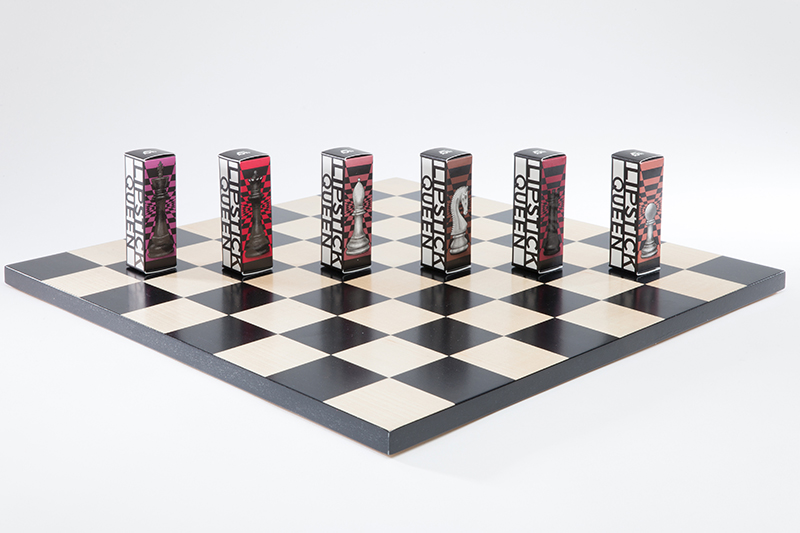
Since its creation in 1986, the World Chess Hall of Fame (WCHOF) has endeavored to highlight the history and cultural significance of the game of chess. The WCHOF’s collection includes a diverse array of chess sets, as well as many chess-themed objects like advertisements, barware, and home decor. This chess-themed lipstick was selected for display in connection with the WCHOF’s current exhibition PINNED! A Designer Chess Challenge, which displays chess-inspired fashion created by the inaugural class of the Saint Louis Fashion Incubator. Through these artifacts, the WCHOF illustrates how chess has evolved through its over 1500-year history and how it is perceived in popular culture.
Lipstick Queen, Lipstick Chess, 2017

Lipstick Queen

Lipstick Chess

2017

Lipstick tube: 2 ⅝ in.

Box: 2 ¾ x ¾ x ¾ in.

Matte lipstick and cardboard box

Collection of the World Chess Hall of Fame

Purling London

Luxury Chess Board

Date unknown

17 ⅝ x 17 ⅝ in.

Wood

Courtesy of Q Boutique

Unable to find matte lipstick in the 1940s-inspired colors she admired, Poppy King created her first brand of lipstick when she was 18 years old. She would later go on to found Lipstick Queen, the company that produces this chess-inspired line. Among the shades are Dashing Mocha Knight, Determined Mauve Bishop, and Ruby Red Queen. King visited the Chess Forum, a shop and game parlor in New York, to learn about chess while developing her chess-themed collection. Purling London, a producer of luxury chess sets, made the chessboard on which the lipstick is displayed.

March

March’s Featured Chess Set is part of the collection of the World Chess Hall of Fame (WCHOF). Since its creation in 1986, the WCHOF has endeavored to highlight the history and cultural significance of the game of chess. The WCHOF’s collection is diverse and includes sets once owned by legendary players, mass-produced sets with lively pop culture themes, antique ivory sets, travel sets, as well as chess computers. Through these artifacts, the WCHOF illustrates how chess has evolved through its over 1500-year history.

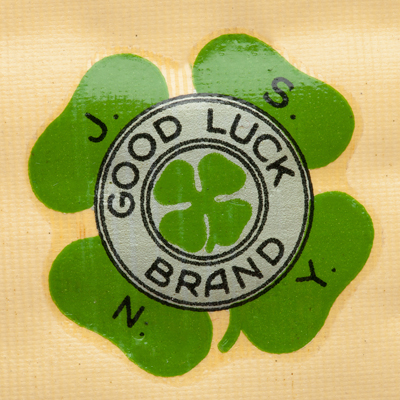
Good Luck Brand Travel Chess Set

J.S.N.Y. (Jeffrey Snyder New York)

Good Luck Brand Travel Chess Set

c. 1970s

King size: 9/16 in.

Case: 4 ½ x 4 x 4 11/16 in.

Plastic

Collection of the World Chess Hall of Fame

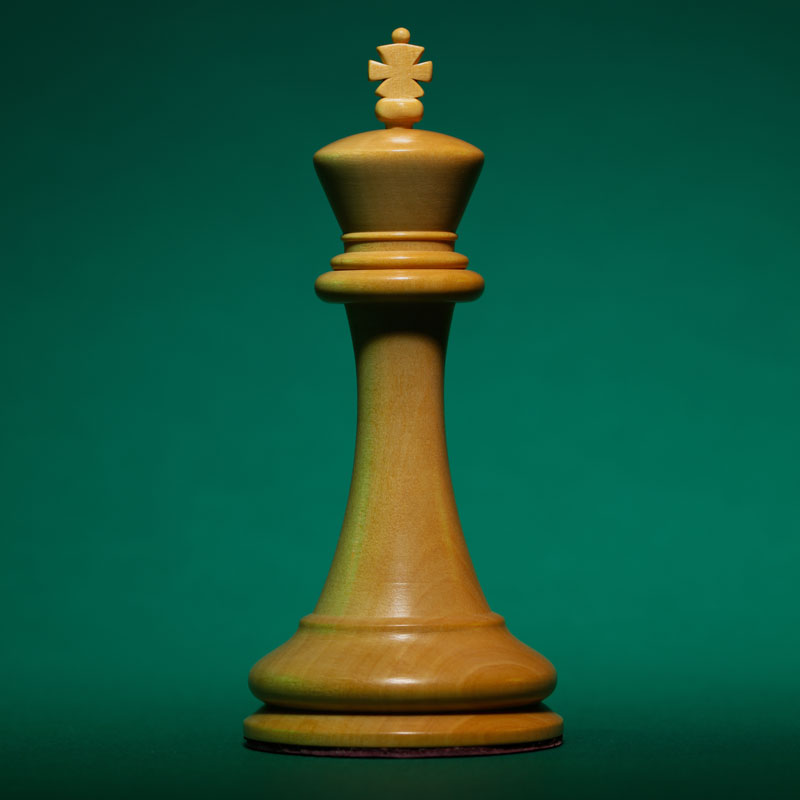
Created to be used while on the go, this diminutive chess set is contained in a carrying case decorated with a shamrock. The red and white pieces have pegs on their bases and the board has corresponding holes, which keep the pieces in place during play. The pieces are miniature versions of Staunton style pieces, the familiar style of chess set used for tournament play. The history of these sets will be examined in an upcoming World Chess Hall of Fame exhibition titled The Staunton Standard: Evolution of the Modern Chess Set, which will open on April 12, 2018.

April

April’s Featured Chess Set is part of the collection of the World Chess Hall of Fame (WCHOF). Since its creation in 1986, the WCHOF has endeavored to highlight the history and cultural significance of the game of chess. The WCHOF’s collection is diverse and includes sets once owned by legendary players, mass-produced sets with lively pop culture themes, antique ivory sets, travel sets, as well as chess computers. Through these artifacts, the WCHOF illustrates how chess has evolved through its over 1500-year history. April’s Featured Set is on view in connection with The Sinquefield Effect: The Resurgence of American Chess, which celebrates the 10th anniversary of the Saint Louis Chess Club.

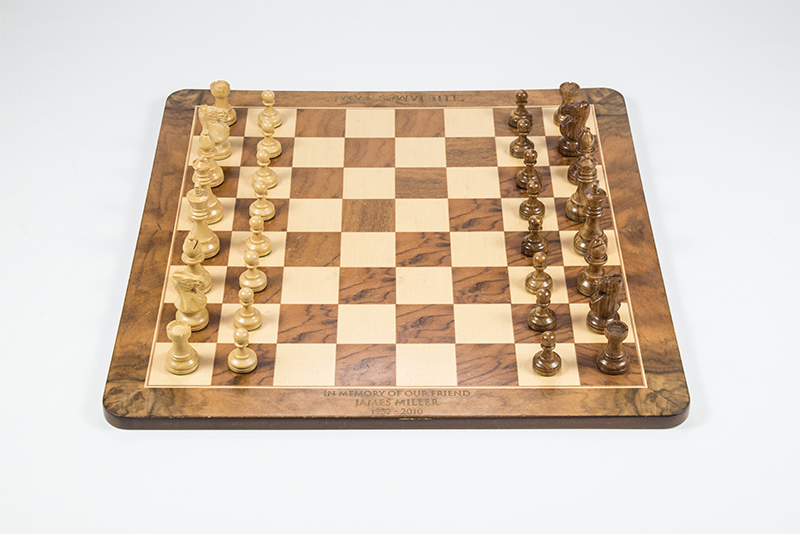
The James Game Chess Set and Board, 2010

The James Game Chess Set and Board

2010

King size: 3 ¼ in.

Board: 21 x 21 in.

Wood

Collection of the Saint Louis Chess Club

This board is inscribed in honor of James “The James Game” Miller and is usually available for play at the Saint Louis Chess Club (STLCC). Miller, who passed away in 2010, was more than just a regular at the STLCC. His outgoing personality and friendly demeanor made him an easily approachable opponent and a joy to play against. James had the ability to make you smile whether you were winning or losing, and his one-liners were a constant source of amusement for members and staff alike. With his death, the Chess Club lost not just one of their most loyal members, but also a part of our family.

The unique brand of chess he brought to the Club on a daily basis earned him the nickname, “The James Game,” characterized by his uncharacteristic openings that could, at times, stymie his opponents. He liked the idea of forcing people out of their element by presenting them with challenging and unfamiliar positions. His upbeat personality and cheery disposition were infectious. James had the ability to brighten the room when he would walk in, and his presence at the Club is sorely missed.

May

May’s Featured Set is on loan to the World Chess Hall of Fame (WCHOF) from Duncan Pohl. Pohl is the author of Vintage Chess Sets of the United States, which includes extensive research about a wide variety of American chess sets and the companies that created them. Pohl is a lender to the WCHOF’s current exhibition The Staunton Standard: Evolution of the Modern Chess Set. The exhibition includes Staunton-style and Staunton chessmen from 1849 to the present day.

Duncan Pohl Set

Hasbro Industries

Hasbro Design East Chess Set

c. 1968-85

King size: 2 3/16 in.

Board: 1 ¾ x 11 ½ x 11 ½ in.

Plastic and cardboard

Collection of Duncan Pohl

Simplified silhouettes of Staunton chessmen appear to float on clear plastic pieces in this inventive set. Hasbro’s advertising hailed the set as “The Game of ages! But in a design no older than ‘now’. This Mars-like planetary set reveres the tradition; has all ‘men’ in one shape, opponent colors identify the pieces. Men are prismatic. A really new interpretation of chessmen—for collector and beginner alike.” The board has alternating brown and blue squares decorated with heraldic symbols: fleur de lis and lions standing on their hind legs. Hasbro, the world’s largest toy manufacturer, created the set.

June

Since its creation in 1986, the World Chess Hall of Fame (WCHOF) has endeavored to highlight the history and cultural significance of the game of chess. The WCHOF’s collection is diverse and includes sets once owned by legendary players, mass-produced sets with lively pop culture themes, antique ivory sets, travel sets, as well as chess computers. Through these artifacts, the WCHOF illustrates how chess has evolved through its over 1500-year history.

Hand-Carved Wooden Chess Set, 1968

Taiwan

Hand-carved Wooden Chess Set

1968

King size: 5 in.

Board: 2 5⁄8 x 18 x 18 in.

Wood

Collection of the Senger Family

June’s Featured Chess Set is on loan to the World Chess Hall of Fame from the Senger family. Andrew Senger received this hand carved chess set as a gift from his grandfather, who had purchased it while stationed at CCK Air Force Base in Taiwan. The set includes pagodas, or tiered towers, as rooks and dragons as the knights. The pawns are individualized, each in a different pose and holding a different instrument.

July

July’s Featured Chess Set was selected in honor of the Saint Louis Chess Club’s tenth anniversary, which is on July 17, 2018. Dr. Jeanne Sinquefield, who co-founded the Club with her husband Rex Sinquefield, designed the set. The two also provided the seed funding to move the World Chess Hall of Fame to Saint Louis and continue to provide support for exhibitions and programming. You can learn more about their effect on chess in the United States and around the world in the World Chess Hall of Fame’s current exhibition The Sinquefield Effect: The Resurgence of American Chess.

Chess 2 Go, 2013

Chess2Go

2013

King size: 1 ⅜ in. dia.

Board: 15 x 15 in.

Plastic

Collection of the World Chess Hall of Fame, gift of the Saint Louis Chess Club

©Chess2Go

Dissatisfied with traditional designs for portable chess sets, Dr. Jeanne Sinquefield, Scoutmaster and Inventor Steve Goldstein, and Life Scout Sam Goldstein conceptualized Chess2Go while camping at Camp Sinquefield in Missouri. They desired to find a replacement for small pieces that were difficult to see but easy to lose and the rectangular boxes that could be uncomfortable when carrying in a backpack. After returning home, they created several prototypes, including one with a neckerchief chessboard. The final result is the set which you can play here, which has a pin to hold the pieces when not in use.

August

August’s Featured Chess Set is part of the collection of the World Chess Hall of Fame (WCHOF). The donors, Dr. Jack and Anitra Sheen, were neighbors of Peter Ganine, the artist who created it. Ganine was a Russian-American sculptor who not only created fine art, but also was a well-known designer of toys and chess sets. He patented one of his best-known designs—the rubber duckie—in 1949. Two of the chess sets he designed appeared on tri-dimensional chessboards in the classic television show Star Trek: The Original Series.

Artist's Proof

Peter Ganine

Artist’s Proof “Conqueror” Chess Set

1962

King size: 6 5/16 in.

Sterling silver and mahogany

Collection of the World Chess Hall of Fame, gift of Dr. Jack and Anitra Sheen in memory of Peter Ganine

These elegant sterling silver and mahogany pieces are upscale versions of those in the plastic Conqueror chess set designed by Peter Ganine. Pacific Games Company, which was based in Hollywood, California, where Ganine lived and where a vibrant chess community thrived in the mid 20th-century, produced the set. The pieces feature solemn-faced members of a royal court whose expressions recall those on the pieces in his earlier “Gothic” chess set. In interviews, Ganine said that by giving the pieces emotions and personality, he wanted to challenge the supremacy of the tournament-style Staunton set, which is the subject of the World Chess Hall of Fame’s current exhibition The Staunton Standard: Evolution of the Modern Chess Set.

September

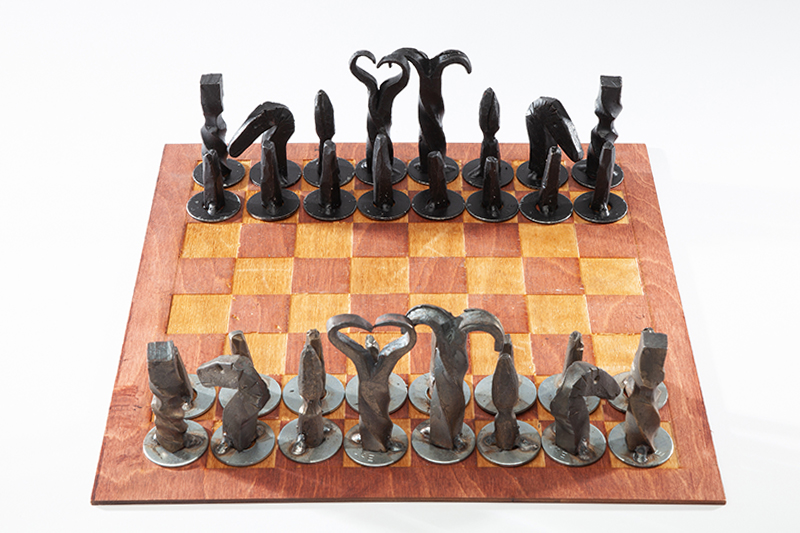
September’s Featured Chess Set is a one-of-a-kind creation designed by Boy Scout Chandler Francis. He produced the set and board at the blacksmithing pavilion and Sinquefield Invention Lab at the Lake of the Ozarks Scout Reservation, Great Rivers Council, which is located outside Laurie, Missouri. Established in 2017, the Sinquefield Invention Lab is named for its founder Dr. Jeanne Sinquefield and has the mission “to facilitate hands-on education and invention of new ideas and technologies, while utilizing problem-solving skills, creativity, and imagination in a team environment. It features a number of tools to foster creativity, including 3D printers, laser engravers, and the epilog laser used to create the board for this set. Sinquefield, who is passionate about the Boy Scouts and was instrumental in the creation of the Boy Scouts of America chess merit badge, is a co-founder of the Saint Louis Chess Club and along with her husband Rex, provided the seed funding for moving the World Chess Hall of Fame to Saint Louis.

Hand Forged Chess Set, 2018

Chandler Francis

Hand Forged Chess Set

2018

King size: 3 ⅜ in.

Board: 11 ¾ x 11 ¾ in.

Steel and wood

Collection of Chandler Francis

Chandler Francis created this unique chess set in order to earn his metalworking merit badge. Earning this merit badge requires learning about alloys, metalworking techniques, and safety as well as choosing one of the four options of sheet metal mechanic/tinsmith, silversmith, founder or blacksmithing and completing a project. With the assistance of camp counselor and metalworking merit badge counselor Justin Tattich, Chandler Francis completed this blacksmithing project. Though scouts are usually only required to create two objects, Francis is passionate about chess and chose to create a full set using a variety of smithing techniques. The set, which is paired with a board made on an epilog laser, brings together old and new skills.

October

October’s Featured Chess Set is on loan to the World Chess Hall of Fame (WCHOF) courtesy of Lawrence Cole. Cole is a member of Chess Collectors International, an organization founded in 1984 and dedicated to the study and promulgation of the art and history of chess artifacts. Cole received his first chess set from his grandfather, who was a chess enthusiast, but did not start seriously collecting until the 1980s, when his work as a minister took him overseas, and he traveled through South America and Africa. He favors unique sets that are handmade and that tell stories of their makers, cultural exchange, or the friends who have helped him build his collection, which now numbers over 300. Cole states that, “All collectors are curators of their collection for their immediate lifetime, and after that, they pass them on to someone else.”

Carved POW Set with Box and Photograph

Max [Last name unknown]

Hand-Carved Prisoner-of-War Chess Set

c. 1940s

King size: 3 3⁄4 in.

Box: 4 3⁄8 x 6 1⁄2 x 9 1⁄8  in.

Photograph: 5 1⁄2 x 3 5⁄8 in.

Wood and felt

Collection of Lawrence Cole

Decorated with hand-carved leaves, this set was created by a German prisoner of war named Max in Scotland during World War II. The number of German prisoners of war in Great Britain peaked in September 1946 at 402,200. Trusted prisoners, like the creator of this set, were permitted to leave camps to complete work assignments at locations across the country.

Max was held in a prisoner-of-war camp in Perthshire, Scotland, and created the set for a friend whom he had met on work assignment, Reverend Colin Finnie Miller, the parish minister at Auchtergaven, Bankfoot, Perthshire. Max can be seen with Miller’s son in the photo accompanying the set. German prisoners of war often created small crafts for sale or as gifts from materials that they had at hand. Lawrence Cole, the current owner of the set, views the set as a powerful symbol of friendship during a time of war. More information about this set can be found in the Spring 2018 edition of the CCI – USA magazine.

November

November’s Featured Chess Set is a pop-culture themed chess set on loan from KTVI-FOX 2. Since its creation in 1986, the World Chess Hall of Fame (WCHOF) has endeavored to highlight the history and cultural significance of the game of chess. The WCHOF’s collection is diverse and includes sets once owned by legendary players, mass-produced sets with lively pop culture themes, antique ivory sets, travel sets, as well as chess computers. Through these artifacts, the WCHOF illustrates how chess has evolved through its over 1500-year history.
Empire Chess Set, 2018

Empire Chess Set

2018

King size: 2 ⅝ in.

Board: 11 x 11 in.

Plastic and wood

Collection of KTVI-FOX 2

Empire Poster, 2018

Empire Poster

2018

19 x 13 in.

Paper

Collection of KTVI-FOX 2

November’s Featured Chess Set is a limited-edition 3D-printed chess set created to promote the fifth season of Empire. Created by Lee Daniels and Danny Strong, Empire premiered on January 7, 2015, and follows the Lyon family and their struggles for control of their music company Empire Entertainment. The show stars Terrance Howard and Taraji P. Henson as Lucious and Cookie Lyons. The poster declares “It’s their move,” and features the pair posing with a chess set. The pieces in the set refer to their characters’ last name—the kings and queens are lions—while others, including a hand holding a microphone and records, refer to aspects of the music industry.

December

December’s Featured Chess Set is from the collection of the World Chess Hall of Fame. Since its creation in 1986, the World Chess Hall of Fame (WCHOF) has endeavored to highlight the history and cultural significance of the game of chess. The WCHOF’s collection is diverse and includes sets once owned by legendary players, mass-produced sets with lively pop culture themes, antique ivory sets, travel sets, as well as chess computers. Through these artifacts, the WCHOF illustrates how chess has evolved through its over 1500-year history.

Handmade Holiday Chess Set, date unknown

Maker unknown

Handmade Holiday Chess Set

Date unknown

King size: 3 1⁄2 in.

Wood, felt, plastic, and cloth

Collection of the World Chess Hall of Fame

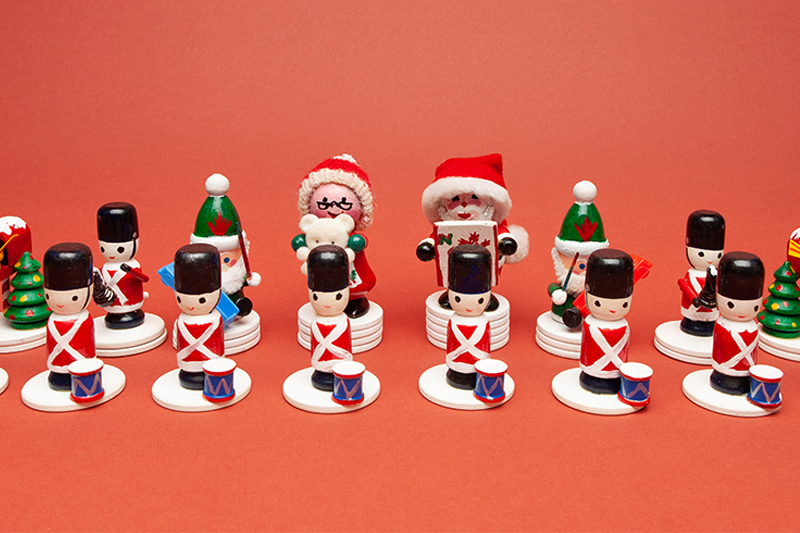
Santa, Mrs. Claus, and an array of toy soldiers face off against an army of snowmen in this handmade holiday chess set made from holiday ornaments and craft supplies as pieces. The set’s creator also reused religious pocket tokens, stacked on top of one another and painted, to build up the bases for each of the pieces, differentiating them by height. The box, lined with a black and white checkerboard pattern, is made from a repurposed silverware box from the H & S Pogue Company, a department store based in Cincinnati, Ohio. The cheery holiday set demonstrates that it is possible to create a fun one-of-a-kind chess set from common household materials.


Loading…

Special Project

Read More

Special Project

Read More

Special Project

Read More

Special Project

Read More

Special Project

Read More

Special Project

Read More